
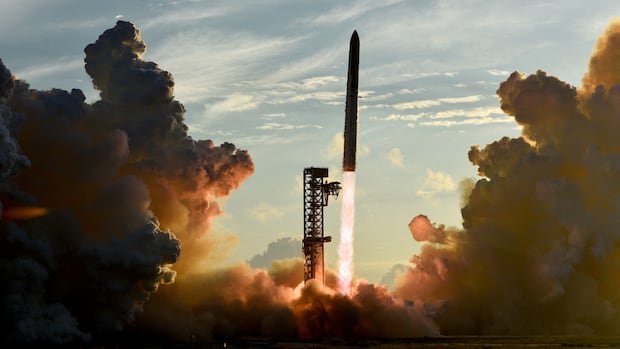

SpaceX successfully launched its massive Starship spacecraft into orbit for the first time on Monday and deployed the most advanced Starlink satellites to date, although the flight was cut short with a splashdown in the Pacific Ocean after over three hours. Originally planned for a 10-hour mission encompassing six orbits around Earth to demonstrate readiness for NASA’s Artemis moon program, the spacecraft faced initial challenges when one of its engines shut down prematurely. Despite this setback, flight controllers proceeded with the mission as the faulty engine was deemed unnecessary.
Elon Musk’s flagship rocket, the largest and most powerful ever constructed, carried 26 cutting-edge Starlink satellites to join the existing fleet of 11,000 units providing internet services. The successful deployment of these satellites garnered cheers from onlookers at the launch site in Starbase, Texas. The decision to end the mission ahead of schedule was made shortly after, without providing a specific reason.
This marked Starship’s 14th full-scale launch from the southern tip of Texas over three years, with previous test flights reaching the Indian Ocean. The recent mission aimed to circumnavigate the globe six times at an altitude of 275 kilometers, but flight controllers opted for an early return after just a couple of laps for safety reasons. The booster stage was not intended to return to the launch site, instead making a controlled landing in the Gulf of Mexico.
SpaceX’s cautious approach is driven by the desire to ensure operational success before attempting to catch and refly the spacecraft using giant mechanical arms. Following Monday’s orbital debut, SpaceX plans to certify Starship for orbital flights, a critical milestone for future missions to the moon and Mars. The company’s ambitious plans include the Artemis III mission next summer, involving multiple spacecraft docking maneuvers around Earth to prepare for lunar missions.
The ultimate goal for Starship is to be fully reusable, significantly reducing launch costs. SpaceX’s meticulous approach, informed by previous test missions and recovered spacecraft data, aims to enhance the reliability and safety of future flights. The company is also expanding its launch infrastructure with additional sites in Florida and Louisiana to support upcoming missions.
Musk’s vision for Starship extends beyond Earth’s orbit, with plans to transport payloads to Mars and revolutionize satellite deployment. The focus for now is on lunar missions and optimizing Starship’s capabilities for various space endeavors, including satellite launches and crewed missions to the moon and beyond.