
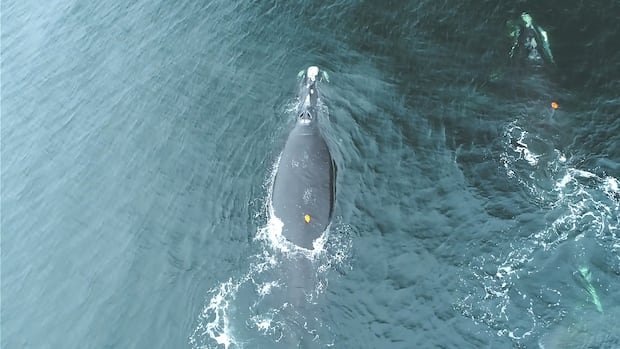

A recent research study has revealed that critically endangered North Atlantic right whales are engaging in nighttime surface feeding, which exposes them to a higher risk of being struck by boats. The findings, recently published in the peer-reviewed journal PLOS One, shed light on this behavior and its implications for preventing fatal collisions between the whales and vessels.
Led by Jay Kirkham, a PhD student at Dalhousie University in Halifax, the study involved tagging 23 right whales in the Shediac Valley, a vital feeding ground in the southern Gulf of St. Lawrence where a portion of the estimated 384 North Atlantic right whale population congregates each summer. The tags collected data, including video footage, on the whales’ movements and feeding patterns.
The video footage captured by the tags revealed the whales’ feeding behavior during the day, showing how they slow down when feeding by opening their mouths like a parachute, necessitating increased tail movement. Kirkham utilized these observations to train a machine learning algorithm to detect nighttime feeding behavior when visual identification was not feasible.
The study highlighted that while right whales typically feed near the sea floor during the day, they rise to higher depths at night in pursuit of zooplankton, bringing them closer to the paths of large vessels. This vertical overlap increases the likelihood of collisions, which, along with entanglements in fishing gear, are the primary causes of mortality among the population.
To address these risks, Fisheries and Oceans Canada and Transport Canada oversee protective measures, including speed restrictions and vessel exclusion zones in the Shediac Valley during the summer. However, the study emphasized the importance of comprehensive conservation strategies, as some tagged whales spent a significant portion of their feeding time outside the protected zone.
Transport Canada highlighted its surveillance program, utilizing visual and audio detection tools for whale protection. The department emphasized the integration of scientific research, monitoring data, and stakeholder feedback in informing protective measures. Fisheries and Oceans Canada echoed this sentiment, stating that the study findings would aid in tailoring management measures to safeguard North Atlantic right whales effectively.