

In the midst of a heatwave and severe drought in the UK this summer, Divya Hariramani was tending to a plum tree in south London when she noticed a troubling issue with one of its branches. The branch was on the verge of breaking away from the tree, a sign of stress in the fruit tree due to the scorching weather conditions.
Hariramani, who shares her experiences documenting fruit trees and their caretakers in London on her social media account called Fruity Walks, explained that the extreme heat had caused the trees to struggle in providing enough water to sustain their parts, leading to branches dropping off.
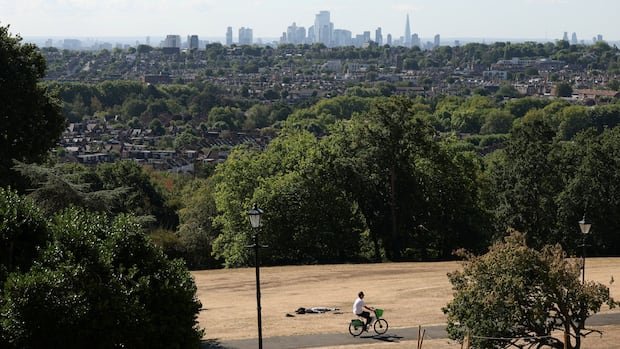
While London is often recognized for its historic stone architecture, the city is also celebrated for its expansive urban forest, considered one of the largest globally. However, this year has presented challenges for the lush canopy as consecutive heatwaves and minimal rainfall have strained the vegetation and wildlife.
According to a recent report from the Royal Botanic Gardens Kew, London’s urban forest faces a bleak future. By the end of the century, approximately 73% of the city’s trees could be at risk of perishing due to the impacts of climate change.
The Kew Gardens tree collections and arboriculture team collaborated with the Greater London Authority to evaluate over a million public trees. Their findings revealed that 62% of these trees are currently ill-suited to withstand the anticipated climate conditions by 2090 without intervention, with an additional 11% classified as vulnerable.
The effects of climate change are already visible, with 400 of Kew’s trees succumbing to extreme heat and drought conditions in 2022. To raise awareness, Kew unveiled a red tree symbolizing the impact of climate change on London’s trees.
The scorching temperatures and drought have taken a toll on agriculture, leading to crop losses, food scarcity concerns, and wildfires in some regions of the country. In London, park grass has withered, tree foliage appears droopy, and leaves have shed prematurely, creating an autumnal scene in the height of summer.
As temperatures in London continue to rise, botanists are contemplating the introduction of different tree species better suited for warmer climates. Joe Richomme, a botanical horticulturist at Kew Gardens, highlighted the need to adapt to a climate similar to Barcelona by 2050.
Paul Wood, a renowned author focusing on London’s trees, expressed concerns about the future of the city’s green spaces amidst the escalating heat and drought. He emphasized the historical and ecological significance of London’s trees, some of which have stood for over a millennium, witnessing centuries of historical events and transformations.
The potential loss of these ancient trees and the biodiversity they sustain would be a devastating blow to London’s natural heritage, underscoring the irreplaceable value of these arboreal treasures.