
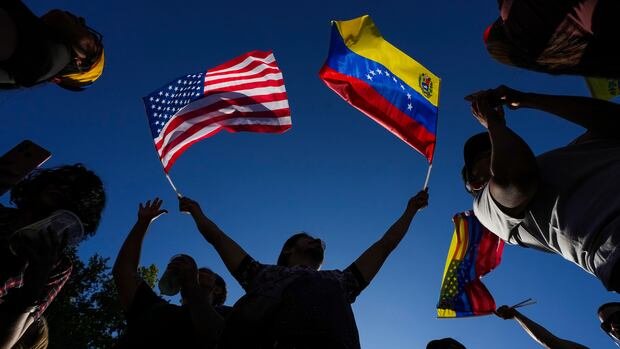

Just shortly after the U.S. military operation in Venezuela and the reported apprehension of President Nicolás Maduro, Katie Miller, the spouse of a key adviser to President Donald Trump, issued a direct message to Canada on social media. She emphasized that the U.S. no longer requires anything from Canada and declared an end to free trade.
This stance aligns with the sentiments expressed by various figures in Trump’s circle, including the President himself. The recent developments in Venezuela, potentially granting the U.S. access to vast reserves of heavy crude oil akin to Western Canada’s production, raise questions about how this could affect Canada’s negotiating position as discussions on the Canada-U.S.-Mexico Agreement (CUSMA) approach.
Experts and former officials shared their insights on the feasibility of boosting Venezuelan oil output and the implications moving forward in a discussion on CBC’s The House. RJ Johnston, from the University of Calgary, highlighted the challenges in Venezuela’s deteriorating oil sector and infrastructure, cautioning that U.S. companies may not readily engage in large-scale ventures in the country without substantial support.
The U.S. government is actively encouraging oil industry leaders to reinvest in Venezuela swiftly, signaling that significant capital injections will be necessary to revitalize the nation’s oil industry and potentially recoup losses from past expropriations. In response, Prime Minister Mark Carney expressed confidence in Canada’s competitive advantage due to its cost-efficient, environmentally friendly oil production compared to Venezuela’s prospects.
Although Canadian energy stocks and heavy oil prices experienced a downturn following the U.S. intervention, the impact on Canada’s economy, particularly in Alberta, could lead to reduced revenue from oil royalties. Kate Kalutkiewicz, a former official in international trade under Trump, emphasized the President’s strategic leverage-seeking approach in negotiations, aiming to diversify trade partners and minimize dependence on any single nation.
While the events in Venezuela may not directly influence trade talks, they underscore the U.S.’s assertive stance in the Western Hemisphere. Canada faces the challenge of expanding economic ties with other nations to demonstrate its negotiating strength. Additionally, Laura Dawson of the Future Borders Coalition emphasized the careful consideration required in trade concessions, given their significant implications for national economies.
Looking ahead, the U.S. has outlined demands for CUSMA renegotiation, including market access for dairy products, addressing provincial bans on U.S. alcohol, and revising online streaming regulations. Despite the complexities of trade negotiations, stakeholders remain optimistic about the resilience of the North American economic relationship, highlighting the importance of maintaining a strong trade structure within the CUSMA framework.