
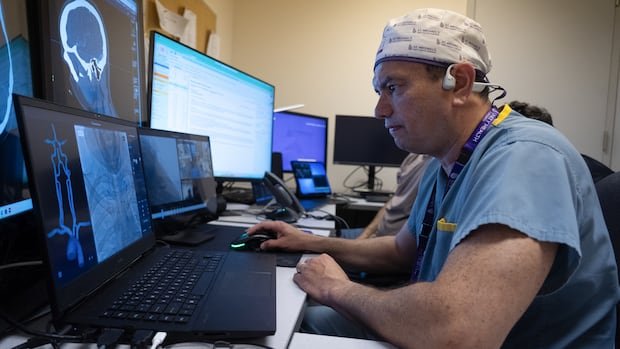

Dr. Vitor Mendes Pereira can conduct crucial diagnostic procedures remotely using a robot and an internet connection. According to Pereira, time is of the essence in these procedures as deploying the robot closer to the patient’s location can save valuable time. The team at St. Michael’s Hospital in Toronto has successfully performed 10 brain angiograms through a remote-controlled robot connected via fiber-optic internet.
Their next goal is to perform a remote endovascular thrombectomy, a surgery to remove blood clots, for a patient located 500 kilometers away in Sault Ste. Marie. While awaiting approval from Health Canada, this procedure, if successful, would be a groundbreaking achievement as the first remote endovascular thrombectomy globally.
This technological advancement is expected to benefit stroke patients in rural areas of Canada and beyond. Dr. Pereira operates the robot from a control room, guiding a catheter through the patient’s arteries and veins while communicating with the on-site operating team. The distance between Pereira and the surgical site has progressively increased in recent procedures.
Safety measures are in place to prevent connection loss during the remote surgeries, as assured by Nicole Cancelliere, the program manager at St. Michael’s Hospital. The potential impact of this technology is deeply personal for Cancelliere, who lost her grandfather to a stroke. She believes this innovation can provide equal access to care for all Canadians.
The first deployment target for this technology is Sault Ste. Marie. Dr. Michael Kutryk of Sault Area Hospital emphasizes the significance of this remote surgery as it can offer timely treatment to stroke patients, improving outcomes and keeping them closer to home. The cost implications of implementing this technology, including the price of the robotic system and operational expenses, need careful consideration.
Despite the initial costs, Dr. Pereira believes that the long-term benefits of this technology, including cost savings and improved patient outcomes, justify its adoption. The team is currently evaluating the cost-effectiveness of the technology, with Pereira highlighting the potential annual savings to the healthcare system. Dr. Pereira is confident that showcasing the time-saving capabilities of the technology will convince health authorities to support its widespread adoption.