
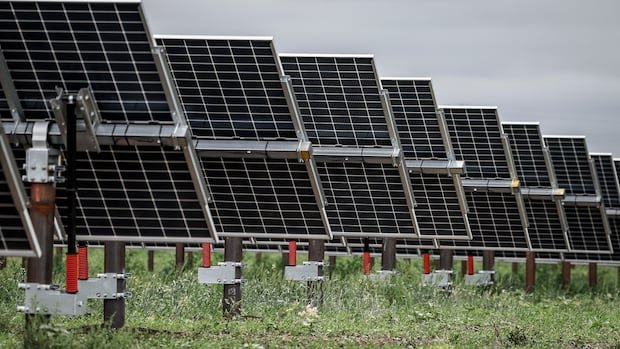

Renewable energy fulfilled all new electricity demand in 2025, as per the latest analysis of global power production, stalling the expansion of fossil fuel-based generation and underscoring the potential of clean sources such as wind and solar. The authoritative Global Electricity Review, issued annually by Ember, an international energy research institution, indicates that clean sources, particularly solar power, are growing rapidly and are cost-effective enough to impede the emergence of new fossil fuel-based electricity production. While solar and wind energy output increased, there was no growth in the electricity generated from burning fossil fuels.
Nicolas Fulghum, a senior data analyst at Ember, highlighted the significant shift in the energy system, emphasizing that solar technology is one of the most scalable solutions capable of driving swift change. However, the situation is less optimistic for Canada, despite its extensive experience in low-emission energy sources like nuclear and hydropower. Solar and wind, now the most affordable forms of energy, contribute to just under nine percent of Canada’s electricity generation, significantly below the G7 average of 19 percent.
Canada’s federal government has introduced the Clean Electricity Regulations, slated to take effect in 2035, mandating a gradual transition to entirely non-emitting sources for electricity generation by 2050. Although there have been recent approvals for new renewable energy projects in Canada, particularly in Ontario, Quebec, and British Columbia, a cohesive federal strategy to expand renewable energy generation is yet to materialize.
According to Fulghum, Canada has not embarked on its power sector’s energy transition to the same extent as many other nations, given the limited share of wind and solar in the Canadian grid. In comparison, the United States leads Canada in wind and solar energy, accounting for 19 percent of its electricity generation.
Despite Canada’s cleaner overall electricity mix, primarily due to its dominance in hydropower, challenges are emerging. The country heavily relies on hydro, which constitutes half of its power generation, while fossil fuels only contribute 23 percent. However, the decline in hydro generation in Canada and other countries in 2025 due to drought impacts underscores the necessity to develop more solar and wind projects.
Prime Minister Mark Carney, in his “Forward Guidance” video message on YouTube, announced plans to double Canada’s clean energy capacity. This aligns with projections from the Canadian Renewable Energy Association and the Canadian Climate Institute, forecasting a doubling of solar, wind, and energy storage capacity in Canada by 2035 based on recent project approvals by provincial utilities.
Recent large-scale procurements of renewable energy in Quebec, British Columbia, and Ontario will substantially enhance their solar and wind capacity in the coming years. Notably, Neoen, a multinational company specializing in renewable energy infrastructure, secured a contract to build two solar plants in Ontario in collaboration with First Nations, including the largest solar project in the province near Sault Ste. Marie.
The rapid global adoption of solar energy, driven by cost reductions and technological advancements, is reshaping the energy landscape. Solar power surged by 30 percent globally in 2025, with solar and wind projected to surpass nuclear power worldwide this year. Battery storage, crucial for integrating more renewables into the grid, experienced a 45 percent cost reduction in 2025, further facilitating the deployment of battery storage systems worldwide.
The accelerated development of solar and wind energy positions Canada to catch up swiftly, with shorter project timelines compared to traditional fossil fuel infrastructure. Fulghum emphasized that even lagging countries like Canada can rapidly adopt solar energy on a large scale due to the expediency and simplicity of solar project development.