
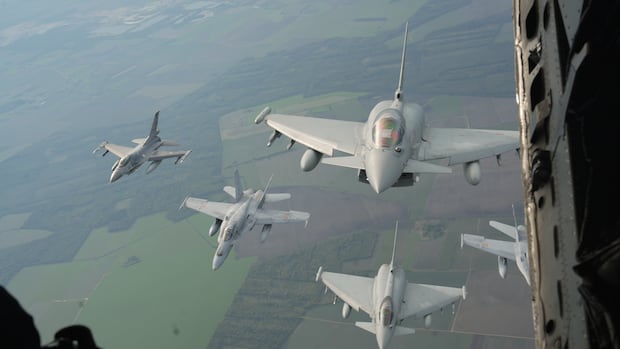

During the national election held this past weekend, many Latvians participated in the voting process unaware that fighter jets from three nations — Turkey, Spain, and Italy — were surveilling the skies above them, ready to respond to any overt Russian attempts to interfere with the election.
“No aircraft can operate without permission in the alliance’s airspace,” stated Capt. Antonio Moncebo, a pilot of the Spanish F-18, whose squadron was stationed at a nearby base in Estonia.
If NATO detects a potential threat, “we initiate a scramble, and we pursue and eliminate them,” he explained.
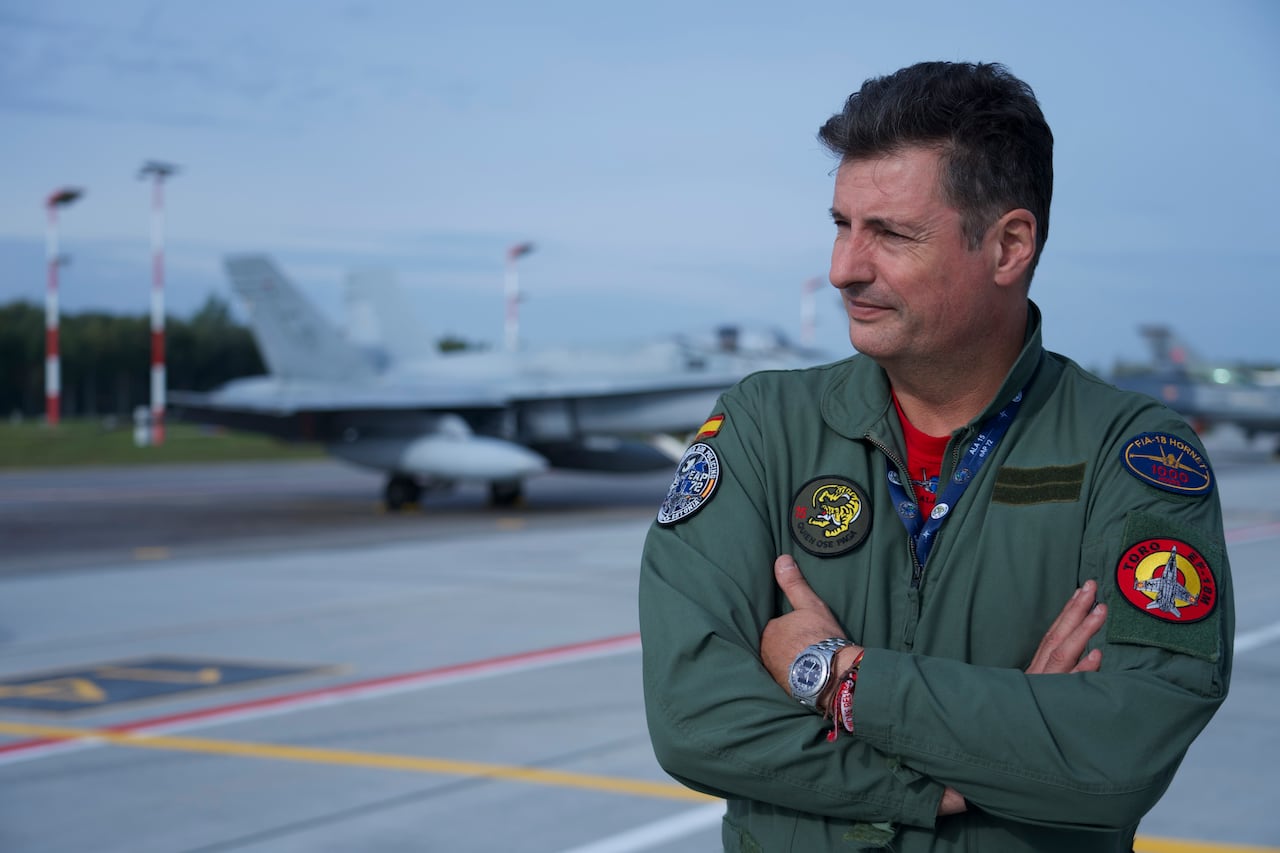
Spanish fighter pilot Antonio Moncebo spoke to CBC News at a NATO airbase in Lithuania. (Jason Ho/CBC)
NATO’s aerial monitoring program, known as the “sky shield,” has transitioned from routine exercises to a crucial operational necessity.
Though many NATO military strategists believe that Russia is unlikely to intentionally ignite a conflict with the Western alliance, there is concern that President Vladimir Putin might test NATO’s determination through provocations that fall below the threshold of war, particularly in the Baltic region.
Incidents such as suspected Russian arson at advanced defense sites in Estonia and a thwarted bombing scheme involving a cargo plane in Germany illustrate how Putin’s intelligence apparatus is increasingly crossing established boundaries to undermine Western support for Ukraine.
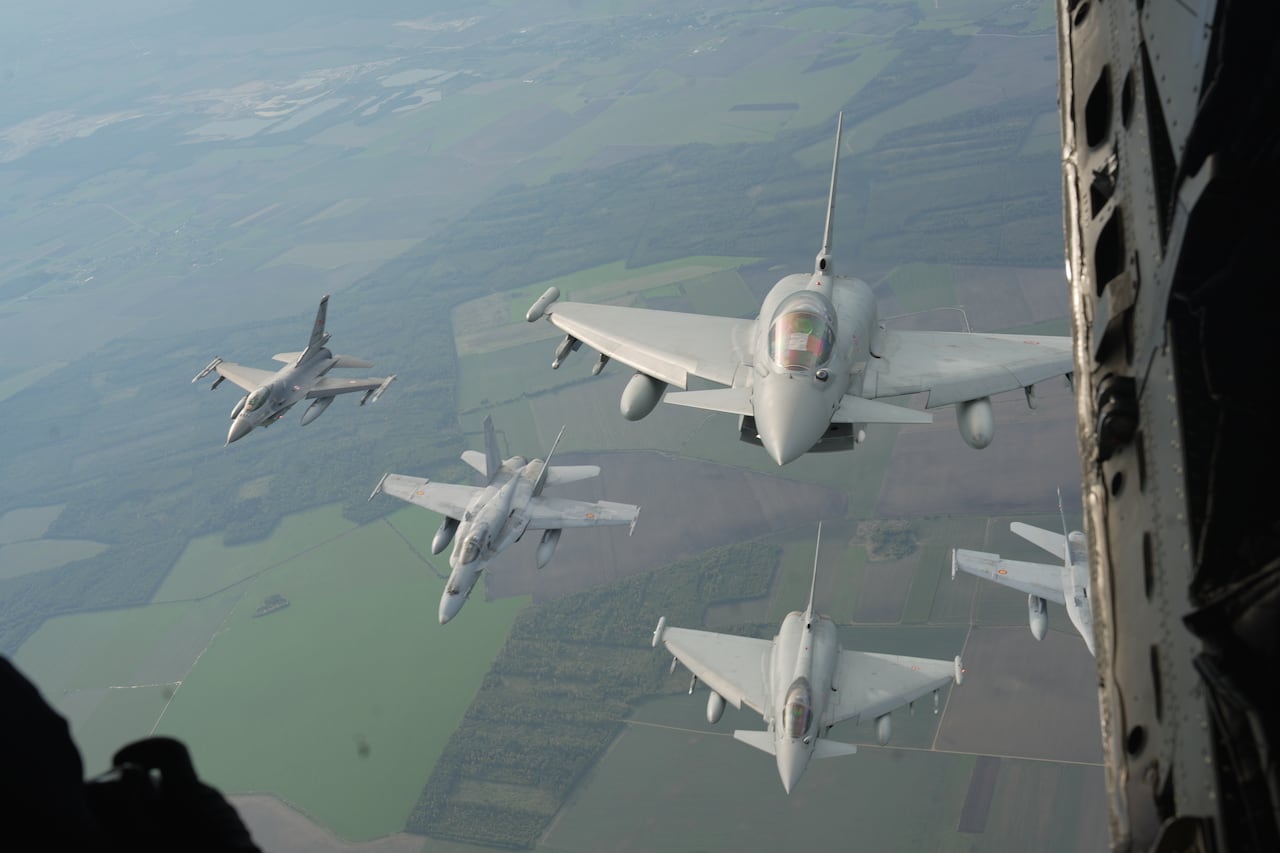
NATO jets from Italy, Spain, and Turkey fly in a close formation over Latvia, as part of a demonstration by the alliance’s air command. (Adrian Di Virgilio/CBC News)
According to Justin Bronk from the British military think tank RUSI, Putin may perceive an opportunity due to U.S. President Donald Trump’s often confrontational stance towards Europe.
“At present, there are significant worries regarding the possibility of Russian aggression against NATO allies, presumably to showcase that the alliance might not respond militarily to an attack on one of its members,” Bronk noted.
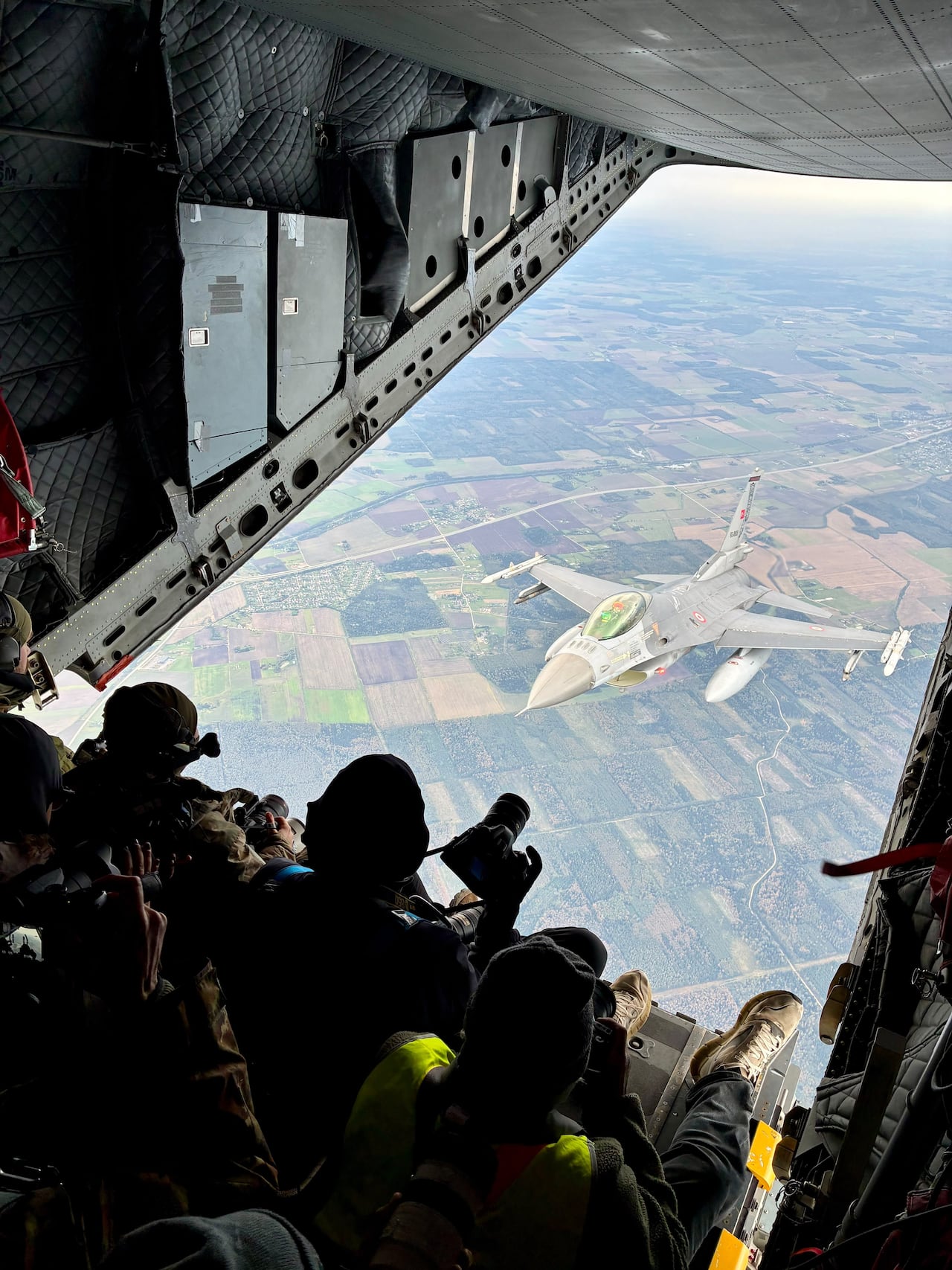
Members of the media, including a CBC videographer, perch at the edge of the ramp in the back of a Lithuanian military aircraft to photograph NATO jets in the sky. The photographers were tethered with harnesses so they wouldn’t fall out. (CBC)
The question of whether NATO is equipped to respond to potential Russian hostilities is a critical one.
Lieut.-Gen. Guillaume Thomas, who oversees air operations over the Baltic nations, dismisses concerns regarding reliance on a Trump-led U.S. military.
“I have complete confidence in the U.S. forces’ commitment to safeguarding the alliance. I witness their ongoing development daily and am assured of their continued support,” he stated.
To demonstrate its preparedness, NATO recently hosted a select group of media, including CBC News, to observe the aerial defense operation over the Baltic region in real-time.
High above Lithuania, military personnel opened the rear ramp of a transport aircraft while in flight, providing journalists with a breathtaking, up-close view of Italian Eurofighters, Spanish F-18s, and Turkish fighter jets flying in tight formation.
Thomas remarked that such close formations symbolize a significant evolution in how the alliance secures its eastern borders.

Spanish and Italian fighter jets fly in a tight formation next to a Lithuanian military plane carrying members of the media. (Adrian Di Virgilio/CBC)
“This represents a shift from an air policing role to an air defense mission,” he explained. “This change allows us to be more responsive, adaptable, and agile, showcasing our capacity to safeguard our airspace.”
Establishing a ‘drone wall’
However, NATO’s aerial defense system is still a work in progress.
The effective and repeated deployment of powerful jet-powered drones by Russia in Ukraine has compelled Baltic countries to quickly reevaluate their domestic defense strategies.
Latvia is currently in the process of developing what it refers to as a “drone wall” along its heavily wooded eastern border.
“This system comprises integrated radar, interceptors, and command-and-control frameworks to detect and, if necessary, neutralize hostile drones,” detailed Airis Rikveilis, state secretary for the Latvian Ministry of Defence.

Police officers stand at the site of a Russian drone strike on the North Bridge in Kyiv, Ukraine, on Oct. 4. (Reuters)
NATO strategists acknowledge that creating a flawless defense system is mathematically unfeasible.
While large fighter jets can intercept significant threats, they are disproportionately costly compared to the small, low-flying surveillance drones.
On the tarmac in Lithuania, personnel operated a new Latvian-designed anti-drone system known as Blaze. It features a propeller-driven interceptor equipped with cameras and a high-explosive warhead that can be deployed to collide with Russian drones from distances of up to 10 kilometers.
However, Blaze is still in the early stages of implementation, and its deployment is not yet widespread.
Rikveilis, the Latvian defense official, acknowledges that more work is necessary to finalize preparations, but he asserts that drone defense is not a weakness for NATO.
The threat posed by Russian drones “is a recent and evolving issue, but it is being effectively addressed.”
The Canadian involvement
Canada is firmly responsible for securing the vulnerable areas underneath any NATO defense gaps.
Over the past decade, Ottawa’s commitment to the region has significantly expanded from a localized battle group to full brigade leadership, positioning as many as 3,000 Canadian troops directly on Russia’s doorstep.

As commander of Task Force Latvia (TFL), Canadian Brig.-Gen. Mason Stalker oversees Canada’s military presence in the Baltic region. He is also deputy commander of Multinational Division-North (MND-N). (Adrian Di Virgilio/CBC)
For the newly assigned Canadian commander in this area, the immediate priority is ensuring the multinational force remains integrated and effective.
“I always focus on ensuring that we possess the necessary combat capability to uphold our NATO commitments,” stated Canadian Brig.-Gen. Mason Stalker.
“And we do. We can escalate our forces as needed.”
While military leaders and pilots express unwavering confidence in air operations, the situation for Latvians on the ground is more nuanced.
The historic Freedom Monument, with its towering stone column in Latvia’s capital Riga, stands as a testament to a nation that fought valiantly to liberate itself from foreign dominance.

A large poster depicting Russian President Vladimir Putin with a skeletal, skull-like jaw is displayed across the road from the Russian Embassy in Riga, Latvia. (Chris Brown/CBC)
For many individuals strolling on the cobblestone streets nearby, the memory of Soviet occupation is not a distant past but a recent experience.
As Russia’s brutal conflict in Ukraine stretches into its fourth year, this history fosters a lingering, low-level anxiety.
“We have a history with Russia, so I fear that something similar could occur again,” stated Leva Rosenberg, a 20-year-old music student in Riga who shared her thoughts with CBC News.
“I live with that fear every day, but I trust that our government will protect us.”
This daily apprehension exemplifies the kind of psychological vulnerability that Vladimir Putin’s hybrid strategies aim to exploit.
Conversely, for some residents in Riga’s Old Town, the clear visibility of NATO and Canadian forces on the ground, along with allied aircraft in the sky, provides a level of security that their grandparents never experienced.
“Latvia is part of NATO,” remarked Lina Valaine. “So I believe that if something were to happen… NATO would respond, and I don’t think Russia desires that at this moment. Therefore, I don’t anticipate any conflict.”