


The iconic cross in Montreal will have its lights switched off on Tuesday.
This famous steel structure, which weighs 26 metric tons and is located atop Mount Royal, can be easily seen against the night sky due to its 240 light bulbs.
According to Jean Carrier, director of the City of Montreal’s road infrastructure division, the cross stands approximately as tall as a 10-storey building, making it a significant landmark visible from all corners of Montreal.
It will be temporarily deactivated for repairs, which are projected to cost the City of Montreal around $3.7 million, as stated by Carrier.
The renovations, anticipated to take about a year, will tackle non-urgent corrosion affecting the central section of the cross, ensure compliance with current building codes, and fortify it against severe weather conditions.
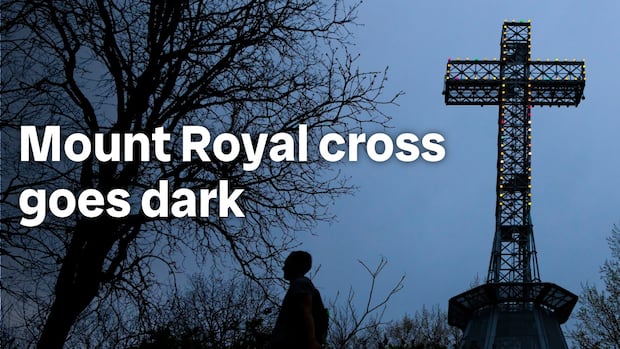
One of the city’s most recognizable landmarks, the cross atop Mount Royal, is undergoing major repairs. The structure’s light bulbs need to be replaced, and weather-caused corrosion has weakened the body of the cross itself.
In total, approximately 25% of the landmark’s 1,800 steel components will be replaced. Additionally, the outdated lighting system will be updated.
The renovation will take place in phases with breaks in between, to minimize disruptions to the nesting periods of local birds and wildlife.
The project is slated for completion by next fall, when the cross will once again illuminate the skyline.
Can a cross be a secular symbol?
Despite being a religious emblem, the cross is exempt from Quebec’s secularism laws, according to Pearl Eliadis, a human rights attorney and law professor at McGill University.
Eliadis stated, “The designation of the cross is that it is essentially a cultural artifact or a historical feature. I believe people perceive a level of hypocrisy in that.”
The current structure was established in 1924, but a cross has existed in this location since 1642, the founding year of Montreal.
Alan DeSousa, a member of the City of Montreal’s executive committee responsible for infrastructure maintenance, remarked, “The cross is part of our heritage.”

The cross on Montreal’s Mount Royal ‘goes deep into our psyche and is part of our identity, it is a unifying force,’ says Alan DeSousa. (Natalia Weichsel/Radio-Canada)
He added, “It resonates deeply within our psyche and forms part of our identity; it serves as a unifying force.”
DeSousa emphasized that the city holds not only a legal obligation but a moral duty to safeguard monuments that reflect Montreal’s identity.
“The community is very invested in preserving this park and the cross, as it is integral to their identity,” DeSousa noted. “They wish to uphold their traditions.”
Eliadis pointed out that the cross’s presence on the mountain is likely not a priority for minority religious groups impacted by Law 9, which has increased emphasis on promoting secularism, including restrictions like the prohibition of public prayer and extending the ban on religious symbols to daycare personnel.
-
With secularism sidelined in Quebec election campaign, here’s where the parties stand
-
How public institutions — like schools and the STM — are handling Quebec’s new secularism law
“I believe the majority of people can accept the cross on the mountain,” she stated. “Very few individuals I know have taken a strong stand on this issue.”
However, she emphasized the importance of recognizing that Law 9 has sought to eliminate religion from public spaces in Quebec.
“If secularism is to be your foremost social value… then, as I mentioned, there appears to be a degree of inconsistency,” she concluded.
Tag: rewrite-pending