


The final moments of Wild Horse Nine unfold in a quiet field on the isolated Rapa Nui, commonly known as Easter Island.
In the passenger seat of a small red vehicle, John Malkovich finds himself beside a Chilean woman, whom he has been threatening with his gun throughout their journey. Ahead of them lies a lifeless horse.
Their discussion revolves around her potential to prevent an imminent military coup in her native land—a coup that, historically, resulted in the assassination of the first democratically elected Marxist president in 1973.
In the film, the CIA operative Chris Carlisle, played by Malkovich, has orchestrated this coup—a grim high point in a career marked by violence, soon to be cut short by the terminal cancer afflicting him.
Carlisle suggests ways this tragedy could have been averted, flashing a morbid grin reminiscent of a (clinically) medicated Jack Sparrow. Her homeland could have chosen a leader favored by the United States. Alternatively, she could have eliminated every soldier she encountered. Or she might have dedicated her life to eradicating any child who showed even the slightest inclination toward militarism and authority before they donned a uniform.
Yet, Carlisle laments, even those drastic measures would have been futile—a darkly humorous yet chilling realization—because there will always be more of them.
“What you should do instead is find a secluded hut on a beach. Somewhere far away. Face away from the ocean and keep an eye on the treeline. Wait there with a gun until they come for you,” Carlisle advises. The underlying irony is that none of this is remotely amusing.
“You will still meet your end. But at least you’ll do so with the wind blowing through your hair.”
Rockwell and Malkovich excel
Does this sound overly cynical? Carlisle would probably concur. Wild Horse Nine is modest in its scope, ambitious in its themes, and brutally honest, serving little comfort in troubled times.
Instead, as it depicts CIA colleagues Carlisle and the anxious Lee Chesterfield (Sam Rockwell) embarking on a bucket-list trip in the days leading up to Carlisle’s demise, it plays more like a darkly comedic buddy film.
In contrast to this year’s more optimistic films like Project Hail Mary or the unexpectedly cheerful Michael Jackson biopic Michael, it critiques the notion of addressing despair with a hopeful narrative. Instead, Wild Horse Nine distracts you from your worries by gripping your neck, directing your gaze into the void, and waiting until you inevitably laugh.
-
REVIEW
Michael Jackson biopic turns up the music and mutes the controversy. What’s wrong with that?
-
REVIEW
Ryan Gosling’s Project Hail Mary is the 1st banger of the year
In terms of comedic and buddy movie dynamics, both Rockwell and Malkovich deliver standout performances. Their collaboration has already sparked considerable Oscar buzz for the melancholic yet smirking Malkovich, and to a lesser extent, for his floundering companion, Rockwell.
Chesterfield emerges as a chronically downcast counterpart to Ryan Gosling and Russell Crowe’s characters in The Nice Guys, reluctantly transporting Carlisle through the ruins of his existence. He guides him past the indifferent Moai statues (the native name for Easter Island’s massive heads)—a fact that nearly leads Carlisle to violence against a group of tourists for mentioning it. He also rushes Carlisle into and out of increasingly uncomfortable interactions with confused locals.
Meanwhile, Carlisle, plagued by a dementia-like memory decline, cannot help but discuss the democratically elected leaders he has eliminated in Africa or even the Democratic presidents he has dispatched from grassy knolls in Texas.
While this sets the stage for a form of zany comedy, it does so while recognizing that there is humor to be found in confronting the overwhelming futility and callousness inherent in existence.
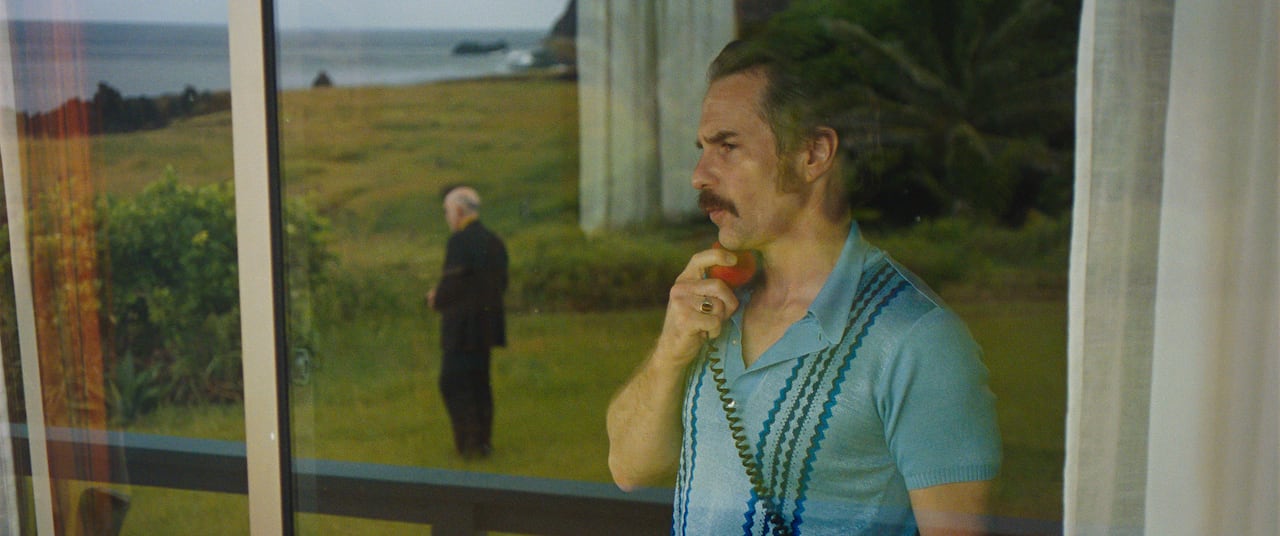
Malkovich, left, portrays the terminally ill CIA operative Chris Carlisle, with Rockwell as his frantic friend and partner Lee Chesterfield. (Searchlight Pictures)
This technique is one that British-Irish writer/director Martin McDonagh has effectively utilized in his other darkly comedic works like Three Billboards Outside Ebbing, Missouri, The Banshees of Inisherin, and the classic In Bruges.
Familiarity with those highly regarded dark comedies should provide insight into what awaits viewers here.
Moreover, Wild Horse Nine is not entirely novel in its alignment with the tone of those films. It recycles the motif of two assassins on an unusual holiday, reminiscent of In Bruges. It borrows the personal tragedy that evokes defeatist, absurdist sorrow from Three Billboards. It incorporates the odd-couple love narrative from Banshees. And there you have it: the formula for the charming, albeit somewhat aimless, quality of Wild Horse Nine.
Resonating a dreary theme in Hollywood
In terms of an espionage tale, there is little intrigue: the audience is aware of who will die and approximately when. Think less Jason Bourne and more JFK.
However, there is one significant distinction. As Carlisle mourns both his own vitality (“She’s life and I’m leaving it,” he tells Chesterfield regarding how a woman’s compassion disorients him) and the lives he has shattered, Wild Horse Nine proves to be even more disheartening than a presidential assassination.
-
Director Alex Gibney on terrifying Musk documentary: ‘It’s not a funeral; it’s a warning’
-
REVIEW
Tom Cruise is fantastic in Digger. You might hate it
This theme is hard to escape in any Hollywood production released this year. From the grim tone of January’s 28 Years Later: The Bone Temple to Spider-Man: Brand New Day‘s continuation of Marvel’s newfound fascination with nihilism.
There’s also the fictional apocalyptic climate-comedy Digger, or the four-hour Musk documentary that humorously concludes with the world’s destruction. And on the horizon looms Luca Guadagnino’s Artificial: a biopic about OpenAI and Sam Altman that depicts AI obliterating all human endeavors and purpose, submitted to the Golden Globes as a comedy.
Given the bleakness of real life, who is actually requesting filmmakers to mirror this back to us in our moments of escape? If the unexpected success of Wild Horse Nine as both a comedy and an extended farewell is any indication, perhaps it’s due to the comfort it provides. Maybe when facing a metaphorical (or literal) gun, there is no greater sense of empowerment than to smile back at it.
Or perhaps, it’s simply that misery seeks company.