
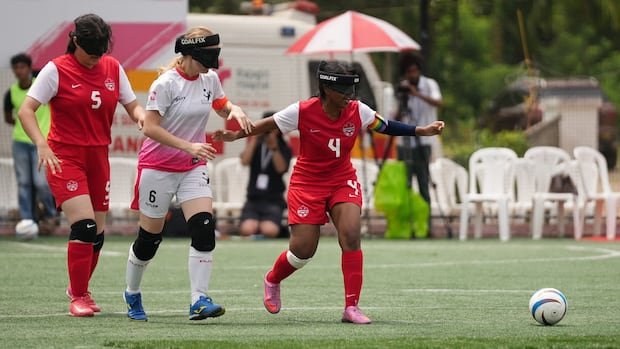

The distinctive sound of blind soccer immediately captures one’s attention. The field echoes with the audible rattling of a ball adorned with small bells, guiding players across the pitch solely by sound. Each team fields five players, all wearing eyeshades to ensure equal footing regardless of any remaining sight. The goalkeeper, the only sighted player, orchestrates the defense from the back, while a guide aids attackers by directing them towards the goal. To prevent collisions, players must shout “voy” – Spanish for “I go” – when approaching an opponent.
For Canada’s women’s blind national team, the challenge lies in introducing a unique version of soccer to the country. Over the past decade, the program has worked diligently to popularize the sport and assemble a competitive team. Competing against Argentina, Mexico, and host Brazil at the IBSA Women’s Blind Football American Championship in São Paulo from September 3-9 marks Canada’s second international appearance.
Since Matt Greenwood’s involvement in 2017, the number of competitive blind soccer players in Canada has grown from eight to approximately 30 nationwide. Through workshops and community initiatives, over 3,500 individuals have been introduced to the sport, with about 20% being visually impaired from birth or legally blind.
Hillary Scanlon, the team captain, unexpectedly lost her vision in 2016 after playing competitive soccer in her youth. Discovering blind soccer online, she found solace in knowing it was a Paralympic sport, yet a Canadian program was non-existent. Connecting with Greenwood through Ontario Soccer in 2022, Scanlon embarked on establishing the program.
Blind soccer necessitates the use of echo boards surrounding the field to serve as reference points for players. However, Canada only possesses one set, obtained post the 2015 Parapan American Games and located far from the national team’s training grounds in Pickering. The team faced challenges due to this shortage, exemplified by Scanlon’s injury during a match in India.
Expanding the sport across Canada poses geographical challenges, with programs primarily concentrated in Ontario and a few other regions. Players like Scanlon travel long distances for training, underscoring the need for more accessible facilities nationwide. Despite facing obstacles, Canada’s national team gained valuable experience at the world championship and secured recognition from Canada Soccer in 2025, marking a significant step towards official recognition and support for blind soccer.
The federation’s collaboration with Soccability Canada has facilitated program administration, covering essential expenses such as uniforms, travel insurance, and registration fees. Additionally, Sport Canada has allocated $50,000 for blind and Para soccer activities in 2026-2027, supporting training camps and international competition. However, funding for the Brazil tournament is not included, prompting players to fundraise or cover their own expenses.
From the absence of blind soccer in Canada to the upcoming international tournament in Brazil, the journey of the national team signifies a remarkable milestone. Greenwood looks forward to witnessing the culmination of years of effort as the players step onto the field together.