
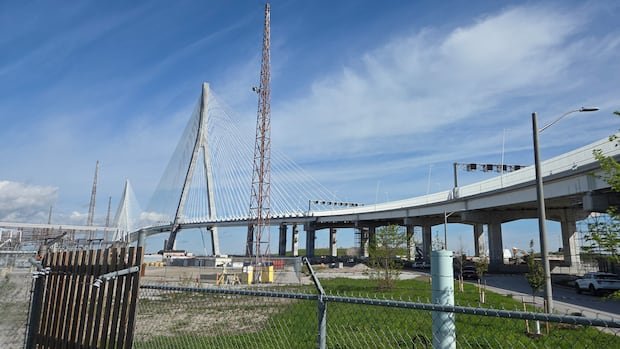

The recent developments surrounding the Gordie Howe International Bridge may have left you feeling a bit perplexed. Canada and the U.S. recently announced an agreement to finally open the bridge connecting Ontario and Michigan after a period of uncertainty. However, there was ambiguity surrounding the terms of the deal, as officials from both countries provided conflicting explanations, particularly regarding revenue sharing and Canada’s debt related to the $6.4 billion construction of the border crossing.
In response to criticism and speculation, Canada made the agreement text available online late on a Tuesday night. Notably, a 2012 agreement that included provisions for toll revenue sharing remains unchanged by the new pact. The key distinction lies in the fact that the 2012 deal involves sharing toll revenue with the state of Michigan in the distant future, while the recent agreement entails sharing revenue with a U.S. federal government-controlled economic development fund for the initial 15 years.
To further clarify, the 2012 Canada-Michigan crossing agreement, announced by then Prime Minister Stephen Harper and Michigan Governor Rick Snyder in June 2012, outlined the legal and financial framework for the project, which was estimated to cost $1 billion at the time. This agreement marked a significant step towards constructing a new bridge at the busiest land border crossing in North America, addressing challenges posed by commercial truck traffic congestion near the aging Ambassador Bridge.
Under this agreement, Canada committed to funding the bridge’s construction, inspection plaza, land acquisitions, and an interchange with the I-75 highway on the Michigan side. Tolls would only be collected on the Canadian side to offset project costs, a process anticipated to span at least 50 years. Once the debt is repaid, toll revenue will be split between Canada and Michigan, the co-owners of the bridge, as stipulated in the agreement.
In contrast, the 2026 Canada-U.S. ‘agreement in principle’ reflects the evolving dynamics, influenced by trade tensions under U.S. President Donald Trump. Following a period of uncertainty and political pressure, an agreement was reached in July 2026 to open the bridge. According to this new deal, toll revenue will cover operational expenses, with any surplus divided equally between Canada and a U.S. government-controlled economic development fund for 15 years, aimed at benefitting trade relations between the two countries.
Moreover, the U.S. government will now have authority over toll rate adjustments, a change from previous arrangements. The upcoming ribbon-cutting ceremony hosted by Canadian officials signifies the bridge’s imminent opening to traffic, following years of planning and negotiations.