
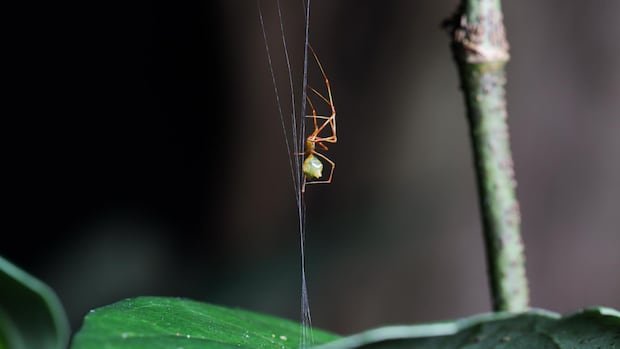

A recent discovery in Australia’s tropical rainforests has amazed scientists with a unique hunting behavior exhibited by a newly identified spider species. This spider utilizes a spring-loaded silk trap to catapult its prey, such as green tree ants, through the air into its web. The study, recently published in the journal Current Biology, details how the spider, known informally as the “ballista spider,” constructs a cone-shaped snare to launch its prey, mimicking the ancient Roman ballista weapon.
Biologist Ajay Narendra, a lead researcher from Macquarie University in Australia, described the observation of this behavior as “breathtaking.” The spider, belonging to the Propostira genus, is yet to be formally classified with a species name.
The initial sighting of this spider occurred in 2022 when researcher Greg Anderson witnessed a green tree ant being flung into a web in a remote rainforest in Queensland’s Cape York Peninsula. Subsequently, a team from Macquarie University conducted further investigations in 2023, capturing the spiders’ hunting tactics using high-speed cameras. The spider, which is nocturnal and measures three to five millimeters in length, spends its days hidden under leaves and constructs intricate traps at night using silk tension lines to capture prey.
The green tree ants are lured and trapped in the spider’s web, demonstrating a specialized prey-hunting strategy. The researchers believe that the silk utilized by the spider may contain pheromones specifically attractive to green tree ants, distinguishing them from other ant species.
The study suggests that the spider’s evolutionary tactic enables it to hunt the formidable green tree ants without direct confrontation. The team plans to further examine the spider silk to identify any specific pheromones used for prey specialization.
The remarkable hunting technique of the ballista spider involves launching its prey with significant force, exceeding the G-force experienced by jet pilots. Compared to the slingshot spider, which has a similar hunting method but differs in its approach of launching itself at flying insects, the ballista spider stores energy in its silk trap to launch prey efficiently while maintaining a safe distance.
The discovery of such fascinating behaviors in nature continues to intrigue researchers, highlighting the ongoing exploration and understanding of the natural world.