
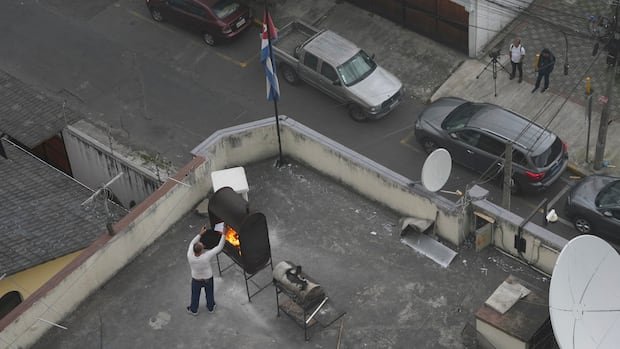

Ecuador has expelled Cuba’s ambassador, Basilio Antonio Gutiérrez, and his diplomatic team, designating them as “persona non grata” and instructing them to depart the country within 48 hours. The Ecuadorian Ministry of Foreign Affairs stated that this action was taken following international diplomatic protocols, although the specific reasons for their expulsion were not disclosed. According to the Vienna Convention, nations have the right to declare diplomatic personnel persona non grata without providing justification.
Shortly after this announcement, an individual was observed on the rooftop of the Cuban Embassy in Quito setting fire to a bag of documents in an oven. Ecuadorian President Daniel Noboa later shared a video on social media capturing the incident, humorously labeling it as a “paper barbecue.” Ecuadorian authorities did not disclose further details regarding the incident or the identity of the individual involved.
In response, the Cuban government expressed strong opposition to Ecuador’s decision, denouncing it as an “unfriendly and unprecedented act” that negatively impacts the longstanding friendship and cooperation between the two countries. The Cuban Foreign Ministry criticized Ecuador’s government for disregarding diplomatic norms and practices observed internationally.
This move by Ecuador follows an executive order issued by President Noboa terminating the diplomatic duties of Ecuador’s ambassador to Cuba, José María Borja, also without explanation. Concurrently, the United States and Ecuador announced joint military operations targeting organized crime groups in Ecuador as President Noboa aims to establish a tough stance against rising violence from armed groups in recent times.
The decision to expel Cuban officials comes amidst increasing pressure from U.S. President Donald Trump on Cuba, which escalated following a U.S. military operation that ousted former Venezuelan leader Nicolás Maduro. Trump’s administration has imposed restrictions on oil sales to Cuba, heightening economic challenges for the country. Ecuador has aligned itself with the United States, collaborating in efforts against drug trafficking and organized crime in the region.
Cuba’s Foreign Minister Bruno Rodríguez suggested a correlation between Ecuador’s expulsion of Cuban diplomats and the U.S.’s pressure on Cuba and other regional governments. The timing coincides with a forthcoming meeting of predominantly right-wing Latin American leaders in Miami, which President Noboa is scheduled to attend.
Ecuador and Cuba have maintained diplomatic relations since 1960, which have fluctuated over the years in response to shifts in Ecuadorian political dynamics.
According to Andrea Endara, a Political Science and International Relations coordinator at Casa Grande University, the decision to expel the Cuban officials carries an “ideological component,” indicating President Noboa’s alignment with U.S. interests.
This recent expulsion of Cuban officials adds to a series of diplomatic tensions involving Ecuador and other Latin American nations in recent history. In 2024, Ecuadorian authorities raided the Mexican embassy to apprehend a former vice-president seeking refuge there, leading to strained relations with Mexico. Additionally, Ecuador has been engaged in a trade dispute with Colombia over alleged lapses in border security measures.