
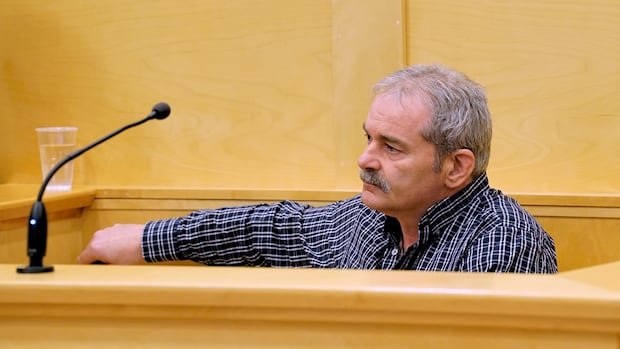

In a murder trial lacking a body and substantial physical proof, Dean Penney’s confessions to an undercover RCMP officer posing as a criminal leader were pivotal. Penney admitted twice to killing his estranged wife, Jennifer Hillier-Penney, and disposing of her remains in the ocean near his cabin. The incriminating videos had a profound impact, with some jurors visibly affected as family members shed tears in the courtroom.
The admissibility of the videotaped confessions to the jury was uncertain from the outset. The RCMP employed a covert technique known as a Mr. Big sting, where officers befriend a suspect and involve them in a fictional criminal syndicate. This strategy culminates in an interview with the syndicate’s leader to extract a confession.
Canadian law generally deems Mr. Big stings inadmissible. Prior to a trial, the prosecution must demonstrate that the confessions’ evidentiary value in establishing the truth of an accusation outweighs any prejudicial effects of the operation. Justice Vikas Khaladkar recently released his pre-trial decision, explaining why he permitted the confessions to be presented to the jury.
The guidelines on Mr. Big stings were chiefly formulated by the Supreme Court of Canada following a 2014 case involving a Newfoundland man accused of his daughters’ murders near Gander. The court ruled that the RCMP had violated Nelson Hart’s rights in that investigation, setting a framework for future court handling of Mr. Big operations.
Khaladkar evaluated seven key aspects of how Penney’s confession was procured, including the duration of the operation, the number of interactions, the nature of the developed relationships, inducements offered, the presence of threats, the conduct of the interrogation, and the accused’s personal characteristics. After considering these factors, Khaladkar found that the confession contained undisclosed details that bolstered the Crown’s case, making it more probative than prejudicial.
As a result, Khaladkar allowed the jury to consider Penney’s confession, leading to a guilty verdict after five days of deliberation. Penney received a life sentence with no parole eligibility for 25 years. Despite maintaining his innocence, he expressed hope for vindication in the future.