
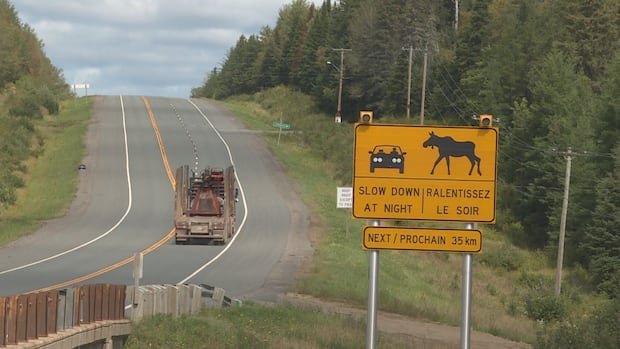

On a dark Saturday evening towards the end of August, the Chaleur Lightning ice hockey team had just finished an exhibition match against the Miramichi Timberwolves and were on their way back to Bathurst on the team bus. Assistant coach Alex Ouellet recalled hearing the bus driver gasp shortly after they started the journey. “It happened within the first five minutes of driving,” Ouellet recounted. “I looked up and saw a figure in front of us, followed by a loud bang.” The team bus had collided with a moose on the highway, but fortunately, everyone on board, including the players and coaches, escaped unharmed, except for a few minor scratches on the driver.
The encounter with the moose left a lasting impression on Ouellet and the team, similar to the experiences of many New Brunswickers who have faced such incidents. Ouellet mentioned, “I will definitely be thinking about it every time I travel those roads, especially in the evening and at night.” Coincidentally, during the same week, the province announced the addition of two new wildlife crossings on the exact highway stretch where the incident occurred.
The province utilizes various methods to prevent moose from straying onto roadways, such as wildlife fencing and crossings. Transportation Minister Chuck Chiasson explained that the placement of these measures is determined based on collision data provided by law enforcement to identify high-risk areas. Currently, 331 kilometers of New Brunswick highways are flanked by wildlife fencing on both sides to mitigate wildlife collisions.
To address the issue further, the province has constructed 82 wildlife crossings, including concrete tunnels under the highways in different locations. Chiasson described the newly installed tunnels on Route 8 between Miramichi and Bathurst as over four meters tall and wide, consisting of 11 pre-fabricated concrete segments. These crossings aim to provide a safe passage for wildlife, such as moose, deer, and bears, reducing the risk of collisions on the roads.
Wildlife ecologist Graham Forbes, who led research on the impact of wildlife tunnels in New Brunswick, highlighted the importance of making the crossings intuitive for animals to use them effectively. Forbes noted that various species, not just large mammals, have been observed using the tunnels, emphasizing their broader ecological significance.
Despite the presence of wildlife crossings, the Department of Transportation has not observed a significant decrease in collisions in recent years. Chiasson emphasized the ongoing efforts to enhance safety measures, including maintaining clear guidelines along the highways to reduce the risk of accidents. Ouellet expressed hope for additional fencing along the highway to improve safety for travelers, acknowledging the challenges of completely preventing such incidents.
As the Chaleur Lightning team continues to travel along the same highway for games, Ouellet remains cautiously optimistic about the effectiveness of existing safety measures. He emphasized the importance of implementing preventive measures to minimize the risk of wildlife-related accidents on the roads.