
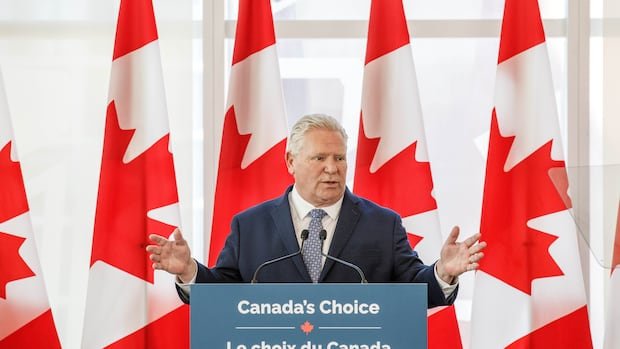

Doug Ford is dialing back his criticism of Donald Trump as crucial trade discussions with the U.S. approach, focusing on building positive relationships with key figures in the president’s circle. Ford recently concluded the first of his three scheduled trips to the U.S. this month to promote Ontario’s “Fortress North America” strategy to policymakers and business leaders.
While Ford has been vocal in his opposition to Trump’s tariff policies, positioning it as a central theme in his successful re-election campaign in early 2025, he now appears to be adopting a more conciliatory approach. When asked about the perceived tension with the U.S. administration, Ford expressed his admiration for the American people and his positive experiences during his visits to the country.
Notably, Ford has previously clashed with the Trump administration, including a standoff over tariffs that led to a proposed surcharge on hydro exports and a controversial anti-tariff ad featuring Ronald Reagan’s voice. Despite these past conflicts, experts suggest that Ford’s current diplomatic efforts are crucial as the renegotiation of the CUSMA trade deal approaches on July 1.
Political analysts point out that while Ford has been a lightning rod in U.S.-Canada relations, his role in shaping trade discussions is significant. As negotiations unfold, Ford’s interactions with various industry stakeholders are seen as pivotal in advancing Canada’s interests. Despite criticisms from opposition parties for not engaging directly with Trump officials, Ford’s strategic meetings with key sectors are believed to be beneficial for fostering positive outcomes.
Ford’s renewed focus on trade discussions comes after a turbulent period at Queen’s Park marked by controversies surrounding a private jet purchase and other policy decisions. Public opinion on Ford’s leadership has been mixed, with recent polls indicating fluctuating support levels. However, as trade and economic issues take center stage, Ford’s advocacy for Ontario’s interests in trade negotiations is seen as a potentially stabilizing factor for his administration.
Looking ahead, Ford faces the challenge of advocating for Ontario’s trade-dependent economy, particularly the auto industry, in the upcoming talks. While navigating the complexities of the negotiations, Ford’s ability to showcase Ontario’s importance as a trading partner and foster collaboration with U.S. counterparts will be critical in securing favorable outcomes.