
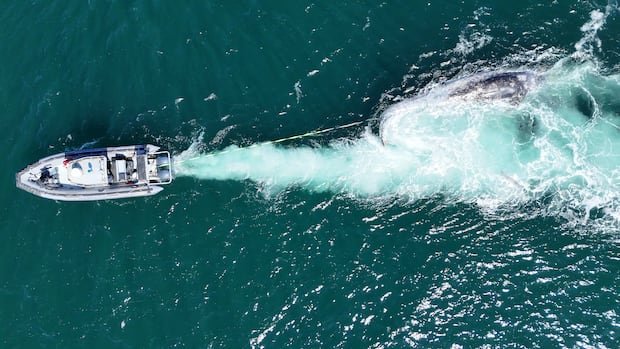

A concerning increase in grey whale fatalities along the British Columbia coast has raised alarms among researchers. The Department of Fisheries and Oceans (DFO) responded to the discovery of four deceased whales within a 10-day period off the western coast of Vancouver Island. DFO marine mammals co-ordinator Paul Cottrell, in collaboration with Huu-ay-aht, Kyuquot/Cheklesaht, and W̱SÃNEÄ First Nations, conducted necropsies on three of the whales. Cottrell noted that two of the whales were severely underweight, describing them as being in a distressing state of emaciation.
The first grey whale was found lifeless near Barkley Sound on April 8, followed by another discovered near Kyuquot on April 9. Subsequently, a third whale was found floating in Barkley Sound the next day, with the fourth whale located off Sidney on April 17. Cottrell expressed shock at the condition of these whales, labeling them as some of the most debilitated he has encountered.
The total count of grey whale mortalities in British Columbia waters this year has reached five, with researchers attributing the deaths to a significant scarcity of prey in the whales’ Arctic feeding areas. Cottrell highlighted the challenging feeding conditions in the Bering and Chukchi Seas last year, which likely contributed to the current crisis.
Research biologist John Calambokidis from Cascadia Research Collective reported 13 grey whale fatalities off Washington state this year, a rate that has exceeded expectations. Similarly, the Marine Mammal Center and the California Academy of Sciences confirmed eight grey whale deaths in the San Francisco Bay Area, raising concerns about the unprecedented speed at which these incidents are occurring.
Grey whales primarily rely on benthic amphipods, small crustaceans found in sediment, as their main food source. Calambokidis noted the documented declines in amphipod populations, which are further complicated by overarching changes in the Arctic ecosystem, particularly the progressive reduction in ice cover.
The declining grey whale population, estimated at just under 13,000, has experienced a concerning decline, with over a 50% drop in numbers over the past decade. The spike in grey whale mortalities in 2019 prompted the declaration of an unusual mortality event, indicating a critical situation for the species.
Cottrell expressed apprehension that this year could surpass previous record highs in grey whale deaths, pointing to the potential for a worse outcome than in 2019. Additionally, concerns about low calf production rates due to the poor health of female whales have been raised, further jeopardizing the species’ survival.
Both Cottrell and Calambokidis anticipate an increase in mortalities as the grey whales continue their migration through June. Increasing research efforts are deemed essential to better understand the grey whale population and its habitat requirements. Encouraging the public to give grey whales ample space and promptly report any distressed animals, researchers underscore the urgency of necropsies to identify the underlying causes of these fatalities and mitigate future threats to the species.