
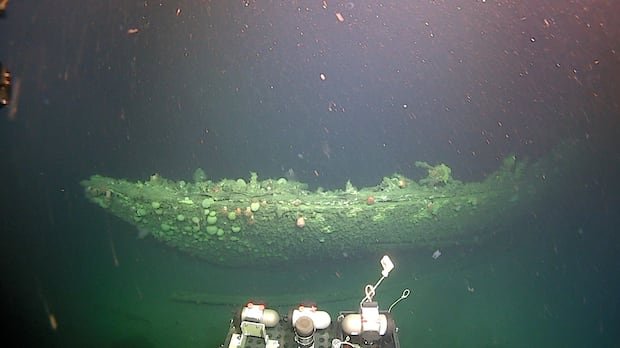

After spending 80 years at the bottom of the Labrador Sea, the Terra Nova has undergone significant changes since its days carrying renowned explorer Robert Falcon Scott to the South Pole. Described as a wreck in poor condition, the ship is currently being studied by a Canadian-led expedition team, with David Mearns, the co-chief scientist, expressing fascination with its state.
Discovered in 2012 off the coast of Greenland by Mearns, this expedition marks the first time detailed imagery of the Terra Nova has been captured. Utilizing remotely operated vehicles (ROVs) and an underwater submersible, the team is also investigating another shipwreck, the Quest, which transported Sir Ernest Shackleton on his final journey to Antarctica.
Recently, the research vessel Atlantis crew utilized an ROV to map the Terra Nova wreck, which was launched in 1884 and sank in 1943, now resting 170 meters underwater near Greenland. Visible features include the ship’s double wheels, rudder, boilers, and steam winches, providing insight into the vessel’s structure.
Technology developed by Voyis, based in Waterloo, Ontario, is instrumental in creating three-dimensional images of the shipwrecks. Marine biologist Kirstin Meyer-Kaiser emphasizes the benefits of these 3D models in enhancing research precision and creating a comprehensive historical record for future analysis.
Dwight Coleman, co-chief scientist and director of ocean imaging at Woods Hole Oceanographic Institution, highlights the advancements in technology, making it easier to capture detailed images without manual photo stitching. This expedition’s focus on Northern shipwrecks not only advances scientific knowledge but also sheds light on lesser-studied maritime sites.
Meyer-Kaiser’s research extends to studying marine life around shipwrecks like the Terra Nova, noting the habitat it provides for fish. By exploring human-made artifacts in oceans, such as shipwrecks and infrastructure, she aims to understand the ecological impacts and predict future outcomes of marine activities.
John Geiger, president of the Royal Canadian Geographical Society leading the expedition, views the exploration of the Terra Nova and Quest as a tribute to their historical significance as pioneering exploration vessels. By documenting these iconic ships with modern ocean technology, the expedition aims to learn from past explorations and honor their legacy in a contemporary context.