

In ancient Greece, pigeons were known for conveying Olympic game results and delivering messages during wartime. More recently in British Columbia, these birds were involved in smuggling drugs into prisons. Now, researchers in Vancouver have enlisted pigeons to assist in enhancing drone technology.
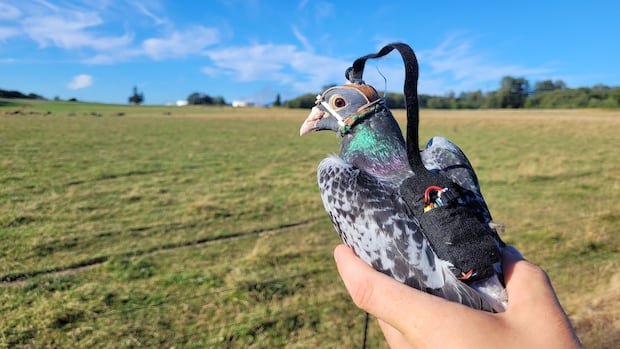
A study led by the University of British Columbia, featured in Current Biology, outfitted homing pigeons with miniature backpacks containing a small computer and head-mounted cameras to monitor their eye movements while flying. The entire setup weighed approximately 27 grams, incorporating a credit card-sized computer, a modified commercial camera, and sensors to track the birds’ movement and orientation.
Anthony Lapsansky, who spearheaded the research at UBC, described the process of equipping the pigeons as a meticulous endeavor that required practice and experimentation. He crafted various falconry hoods to secure the cameras on the birds’ heads and fashioned backpacks for the remaining equipment. The pigeons were gradually accustomed to the gear by initially wearing fake backpacks before the actual equipment was attached.
The study involved a group of around 16 pigeons released along a familiar route, returning to their loft where the researchers could retrieve the recorded footage after removing the equipment.
Findings from the UBC study revealed that pigeons make subtle eye movements during flight, potentially aiding in gathering detailed environmental information. The research also observed the pigeons converging both eyes inward when landing on a perch, suggesting a mechanism for processing depth similar to humans.
Contrary to prior assumptions, the study challenged the notion that pigeons maintain fixed eyes while flying. David Bird, a wildlife biology professor at McGill University, noted that an earlier study from the California Institute of Technology suggested otherwise, emphasizing the varying behaviors of pigeons based on flight conditions.
The UBC research has implications for drone technology, indicating that drones could benefit from more adaptable cameras that mimic the dynamic eye movements observed in pigeons. Bird, with extensive experience in drone operations, highlighted the potential for improved drone performance with sophisticated, maneuverable cameras.
In conclusion, the study sheds light on the unique eye movements of pigeons during flight, offering valuable insights for enhancing drone design and functionality.