
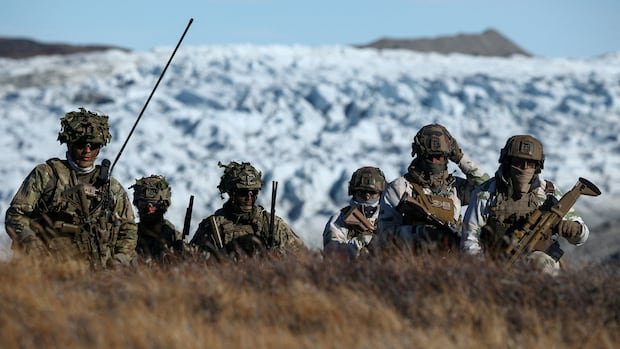

NATO’s Secretary General, Mark Rutte, demonstrated a cautious approach in responding to President Donald Trump’s comments about the potential deployment of European troops in Greenland. Reports surfaced suggesting that the U.K. and Germany, among other countries, are considering a military presence on the Arctic island as a precaution against American actions.
President Trump’s assertive stance on Greenland and his military threats against the Danish territory have brought attention to long-overlooked issues by both NATO and the United States. Rutte indirectly acknowledged ongoing discussions among European nations regarding enhanced Arctic security but downplayed their significance as a continuation of prior talks initiated by seven allied Arctic countries, including the U.S.
“We are collaborating to ensure the safety of the Arctic region and are currently exploring the next steps to achieve practical outcomes from these discussions,” Rutte stated. Emphasizing the collective responsibility of the alliance and individual allies to maintain Arctic security, he underlined the shared priority of safeguarding the region.
Efforts seem aimed at persuading President Trump that NATO shares his interest in strengthening defenses on the island. This development is noteworthy as Arctic security had been a neglected issue for both the U.S. and NATO for many years. However, a shift in attitude towards the region emerged in Washington in 2022 and intensified during the second Trump administration.
While Canada has increased its focus on Arctic policies and allocated additional funds for the Far North, NATO has been caught unprepared for heightened security pressures from the U.S. Notably, NATO lacks an official Arctic policy or a specialized command dedicated to the region, as highlighted in a recent report by the Arctic Institute Center for Circumpolar Security Studies.
Recent advancements, such as the U.S. Northern Command taking over responsibility for Greenland from the U.S. European Command, indicate a strategic shift perceiving Greenland as part of the U.S. homeland defense network. This move aligns with Washington’s view of Greenland’s significance in defense planning and underscores the evolving dynamics in the Arctic region.
The significance of Greenland’s rare earth mineral deposits and geopolitical interests in the region have also drawn attention, with China’s efforts to invest in the island facing challenges due to geopolitical complexities. Greenland’s critical minerals sector, particularly rare earth minerals, has become a focal point for international interests and strategic considerations.
Overall, the evolving discussions and developments surrounding Greenland underscore the shifting priorities and strategic calculations within NATO, the U.S., and other stakeholders regarding Arctic security and resource interests.