
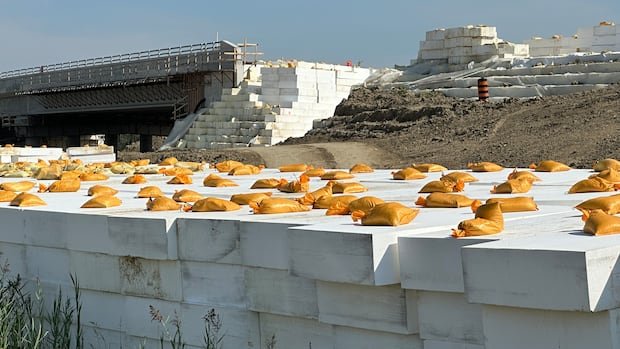

Large, white building blocks resembling oversized Lego pieces can be seen stacked near the new overpass project at Banwell Road and E.C. Row Expressway interchange. These blocks, known as Expanded Polystyrene (EPS) geofoam blocks, are being used by construction crews to construct embankments for the new overpass, as confirmed by the City of Windsor.
Jill Braido, a city spokesperson, explained that EPS blocks are utilized in construction projects to prevent ground settlements by employing a construction method called ‘compensated foundations’. Instead of directly building bridge overpass approaches on regular soil, crews are replacing a significant amount of soil with EPS blocks before constructing the final road cap on top.
According to Mina Lee, a civil engineering professor at the University of Windsor, geofoam blocks are chosen over soil due to their lightweight properties, being 100 times lighter than soil. This helps reduce the load on the ground, especially in areas like Windsor with clay soil prone to settlement over time.
The use of EPS blocks not only ensures the long-term stability of the bridge overpass approaches but also reduces overall labor costs compared to traditional heavy soil or gravel fill materials. This construction approach has become a common practice in Windsor’s road infrastructure and was also utilized in the construction of the Gordie Howe International Bridge.
Unlike styrofoam that easily crumbles, these geofoam blocks are engineered to withstand heavy loads without cracking. They are highly compact, manufactured in controlled environments, and designed to carry the necessary weight effectively.
In addition to their structural benefits, there are environmental advantages to using geofoam blocks. Due to their lightweight nature, they are easy to transport, reducing greenhouse gas emissions from transportation compared to soil. Furthermore, the blocks are made from recycled materials, allowing for potential recycling after the infrastructure’s lifespan.
Lee estimates that the geofoam blocks have a lifespan of 50 to 100 years, providing a durable and sustainable solution for construction projects in Windsor.