
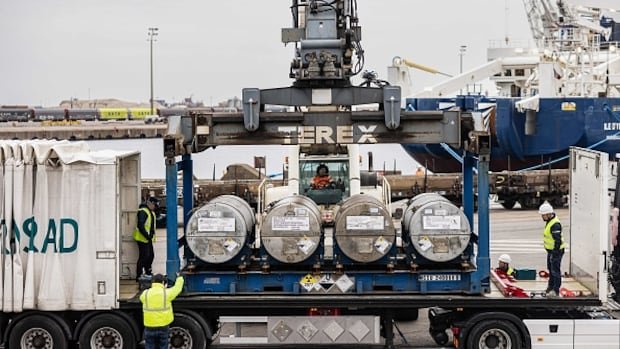

Amid the ongoing conflict in Ukraine with Russian forces controlling the country’s major nuclear plant and targeting its power infrastructure, Europe and the United States continue to rely on Russian nuclear fuel for their electricity needs.
One of the recipients of low enriched uranium (LEU) from Russia for fueling commercial nuclear reactors in the U.S. is Canadian-owned Westinghouse Electric, as revealed by shipping data analysis conducted by CBC’s investigative program “the fifth estate.”
The U.S. took steps to ban the import of Russian enriched uranium in August 2024 to reduce reliance on Russian resources. However, exemptions are allowed under the Prohibiting Russian Uranium Imports Act if no alternative source of LEU is available or if the import serves national interests, with waivers set to expire by January 1, 2028.
In 2025 alone, the U.S. imported 400 tonnes of low enriched uranium from Russia valued at approximately $1 billion, with major recipients including subsidiaries of French-owned Framatome, U.S.-based Global Nuclear Fuel Americas, and Westinghouse.
While the U.S. has taken measures to reduce dependence on Russian nuclear fuel, the European Union has not implemented a ban on Russian enriched uranium imports. Additionally, Canada has not sanctioned business dealings with Russia’s state nuclear corporation Rosatom or its export entity, Tenex.
Efforts to decrease reliance on Russian nuclear resources are being emphasized, with calls for all countries to reduce cooperation with Russia and seek alternative sources of nuclear fuel.
Westinghouse Electric, a significant player in the U.S. nuclear industry, is majority-owned by Brookfield Renewable Partners and holds a stake by Cameco Corporation. Despite inquiries, Westinghouse and Brookfield did not provide comments for this report.
The U.S. Energy Information Administration does not disclose the exact amount of uranium purchased from Russia due to privacy regulations. However, Russia remains a major supplier of enriched uranium globally, supplying a significant portion used in the U.S. and Europe.
The U.S. and Europe have historically relied on Russian enriched uranium, prompting efforts to diversify sources and enhance domestic production. Westinghouse’s involvement in nuclear projects, including collaborations with Ukraine, reflects ongoing initiatives to reduce dependency on Russian resources.
As Western nations strive to reduce reliance on Russian nuclear fuel, the need to bolster domestic production and establish alternative supply chains is recognized as a long-term goal in ensuring energy security and independence.