
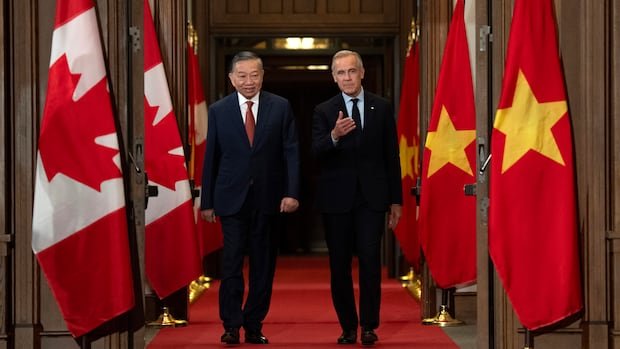

Vietnamese President Tô Lâm has elevated the relationship with Canada to a strategic partnership, following Prime Minister Mark Carney’s initiatives to enhance collaboration among middle powers in response to pressures from the United States and China. “In an unpredictable global environment, trust, responsibility, and shared interests are strategic assets,” Lâm stated during his address on Parliament Hill.
During his one-day state visit, Lâm engaged in various activities, including planting a tree at Rideau Hall and delivering a speech to parliamentarians and members of the diaspora. As the first Vietnamese president to visit Canada, Lâm, who also leads the country’s communist party, holds a significant position.
In a meeting at Carney’s West Block office, the prime minister praised Lâm for his leadership as a middle power and highlighted the rapid progress in the relationship since a 2017 agreement covering investment, defense, and academia. Carney hinted at potential direct commercial flights between Canada and Vietnam, indicating positive developments in the partnership.
The deepening strategic partnership indicates a commitment to long-term collaboration on key objectives, according to Vina Nadjibulla, co-founder of the Centre for Strategic Statecraft. Vietnam, despite being a communist nation, shares similarities with Canada in its trade dependence and commitment to upholding the rules-based international order.
The renewed partnership will focus on cooperation in energy, agriculture, defense, and people-to-people connections, as highlighted by Foreign Affairs Minister Anita Anand. Canadian expertise in areas such as technology, agriculture, clean energy, and education will support Vietnam’s transition to an innovation-driven economy.
Vietnam and Canada enjoy a robust trade relationship, with bilateral merchandise trade exceeding $20 billion last year. The countries engage in the exchange of various goods, with Canada exporting food, metals, and fertilizers, while Vietnam exports electronics, clothing, furniture, and shoes.
As part of efforts to reduce dependence on the United States, Vietnam is exploring trade diversification and pursuing bilateral agreements. Both countries share a common goal of diversifying supply chains and reducing reliance on the U.S. market.
Vietnam’s leadership in addressing forced labor in supply chains aligns with international efforts to combat such practices, including those linked to Uyghur slave labor in China’s Xinjiang region. Canada’s engagement with Vietnam reflects a broader strategy of enhancing trade diversification and diplomatic ties with key partners.
The partnership with Vietnam is significant within the context of the Comprehensive and Progressive Agreement for Trans-Pacific Partnership (CPTPP), which promotes rules-based trade and labor rights. Lâm’s support for closer collaboration between the CPTPP bloc and the European Union underscores the importance of middle powers uniting against coercive economic policies.
Canada’s history of providing aid to Vietnam and resettling refugees from the region has fostered goodwill between the two nations. Lâm emphasized Vietnam’s commitment to independence and peaceful coexistence with other powers, praising Canada’s contributions to areas such as landmine clearance, peacekeeping, and environmental protection.
The visit by President Tô Lâm aligns with a trend of foreign leaders engaging with Canada following Carney’s initiatives to expand trade and diplomatic relationships. Recent diplomatic exchanges with leaders from countries like the Philippines and Norway, along with the upcoming visit by Indian Prime Minister Narendra Modi, underscore Canada’s growing role as a middle power on the global stage.