
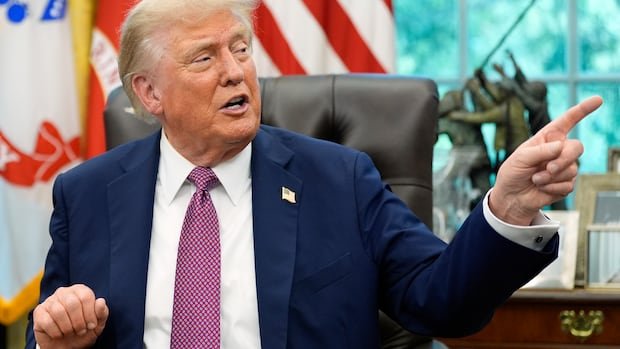

President Donald Trump expressed his determination to maintain the United States’ leading position in artificial intelligence (AI), dismissing critics as promoting unlikely scenarios. During a press briefing at his golf course in Ireland, Trump emphasized the importance of the U.S. retaining its edge in AI, citing the significance of AI supremacy.
Trump’s visit to Ireland included discussions with President Catherine Connolly and Prime Minister Micheál Martin before attending the Irish Open tournament at his golf course. The debate surrounding AI has intensified in the U.S., with concerns raised by experts warning of potential risks associated with the rapid advancements in AI technology.
Despite the warnings, Trump’s administration has shown support for AI companies, with industry leaders backing his initiatives. Notably, there has been a surge in financial support from AI executives towards the upcoming election, with SpaceX CEO Elon Musk’s political action committee playing a pivotal role in supporting Republican candidates.
Following the concerns raised by researchers, some AI CEOs are advocating for a more cautious approach towards AI development. Anthropic CEO Dario Amodei proposed a three-step framework aimed at regulating the pace of AI progress to mitigate risks, gaining support from prominent figures in the AI industry such as Musk and OpenAI CEO Sam Altman.
Amodei highlighted the challenges in establishing a “speed limit” for AI advancement, particularly in the context of the competitive landscape between U.S. and Chinese AI companies. He emphasized the need for stringent measures to prevent potential risks associated with unchecked AI development, acknowledging the complexity of balancing progress with safety concerns.
Jacob Coxon, a former Anthropic researcher who issued warnings about AI risks, underscored the importance of international collaboration to ensure responsible AI development. Coxon stressed the need for coordinated efforts to prevent a technological race with China that could pose significant dangers.
The debate surrounding AI regulation and safety measures continues to evolve, with stakeholders emphasizing the need for thoughtful and strategic approaches to harness the potential of AI while safeguarding against potential risks.