

U.S. President Donald Trump expressed his support for the unification of British-run Northern Ireland with Ireland during a visit to Dublin, sparking criticism from pro-British unionists in Northern Ireland. Trump’s remarks followed British Prime Minister Andy Burnham’s recent statement that a referendum on Northern Ireland leaving the United Kingdom was not on the table, a stance reaffirmed by Downing Street.
Speaking alongside Irish Prime Minister Micheál Martin in Dublin, Trump stated his enthusiasm for seeing Northern Ireland and Ireland unified, suggesting it would be a positive development. Trump acknowledged that the United Kingdom would have a say in the matter but reiterated his belief in the potential benefits of Irish unity.
Trump’s comments diverged from the neutral stance maintained by previous U.S. presidents, such as Bill Clinton, who played a crucial role in negotiating the 1998 Good Friday Agreement. The agreement, which ended decades of conflict between Irish nationalists and unionists, stipulates that any referendum on Irish unity requires the consent of the British government.
While polls indicate a majority in Northern Ireland prefer remaining part of the U.K., the issue of unity has gained prominence following Brexit, with some advocating for closer ties with Ireland. The leader of the Democratic Unionist Party, Gavin Robinson, dismissed Trump’s remarks, emphasizing that Northern Ireland’s future should be determined by its people rather than external commentary.
Supporters of Irish unity in Belfast cautiously responded to Trump’s statements, with some viewing them as mere sensationalism. Previous U.S. presidents, including those with Irish heritage like Joe Biden, have traditionally maintained a neutral stance on Irish unification, recognizing the delicate political dynamics at play.
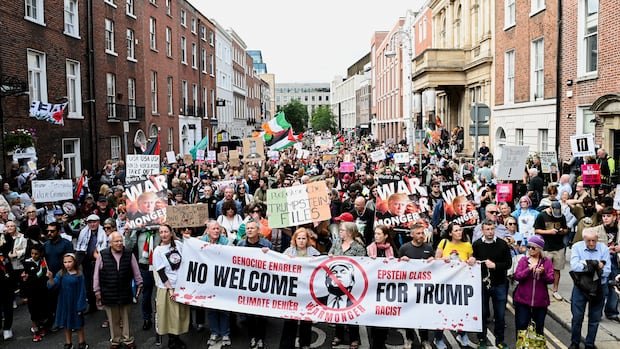
After departing for a golf tournament at his Irish resort, Trump faced protests in Dublin, with demonstrators criticizing his foreign policies and advocating for various causes. The protest marked one of the largest anti-war demonstrations in Ireland in recent years.