
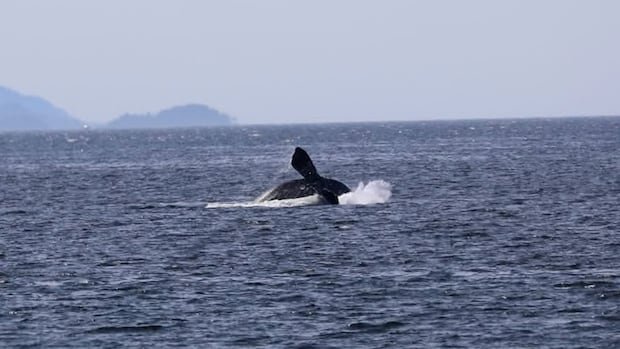

Troy Bright, a seasoned researcher stationed off Malcolm Island, had a rare encounter on Sunday when he sighted a whale unlike any he had seen before. Documenting whales for over three decades with Bere Point Research, Bright grabbed his camera to capture this unusual whale breaching multiple times in front of him. Noting its distinctive short and black pectoral fins, Bright determined it was not a humpback whale but an endangered North Pacific right whale, confirmed by him and other cetacean experts.
Jared Towers, a cetacean research technician with the Department of Fisheries and Oceans (DFO) residing in Alert Bay, embarked on a lengthy search for the elusive whale. Towers revealed that the whale was initially hard to spot, only discovered because it was floating at the surface with a piece of kelp.
This juvenile North Pacific right whale sighting off Malcolm Island is a significant event, as these whales have been sighted in British Columbia only seven times. This particular population is critically endangered, with fewer than 50 individuals, making this sighting a positive indicator for their conservation. Towers highlighted the importance of this sighting, suggesting it might be the first documented sighting of a juvenile right whale.
The scarcity of North Pacific right whale sightings in Canada has limited researchers’ understanding of the species, including their birthing grounds. In a collaborative effort back in 2024, DFO, in conjunction with NOAA scientists, used sonobuoys to detect acoustics, identifying the whales near Langara Island close to Haida Gwaii.
The recent sighting in Canadian waters has piqued the interest of researchers in the U.S., notably Kevin Campion, the founder of Save the North Pacific Right Whales. Campion emphasized the grave impact of past human activities on the whale population and stressed the need for conservation efforts to aid in their recovery.
These North Pacific right whales are filter feeders, consuming copepods, tiny aquatic crustaceans, by swimming with their mouths open. The sighting on Sunday has sparked optimism among researchers for further insights into these rare creatures and the necessity of safeguarding their vital habitats.