
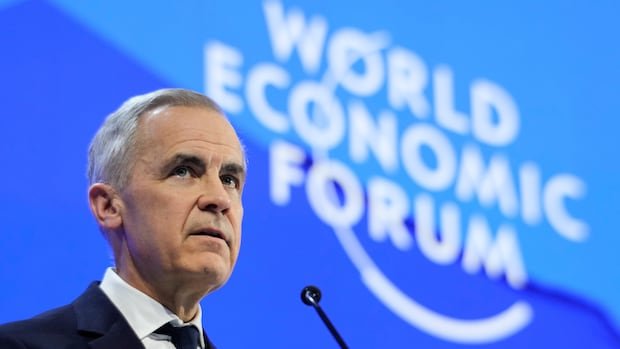

Prime Minister Mark Carney made a significant impact in Switzerland on Tuesday during the World Economic Forum in Davos by delivering a bold assessment of the current global situation. Carney emphasized that the traditional international order is a thing of the past and will not return, describing it as an illusion from the start.
In his speech, Carney pointed out the flaws in the international rules-based order, highlighting how the strongest nations often exempt themselves when convenient, and how trade rules are not uniformly enforced. He stressed that international law is applied inconsistently based on the identities of those involved.
Former diplomat Sen. Peter Boehm described Carney’s speech as one of the most important delivered by a Canadian prime minister since Louis St. Laurent outlined Canada’s post-Second World War foreign policy direction in 1947. The speech was seen as a call for a new approach to global relations, urging middle powers like Canada to collaborate and assert their interests collectively.
Carney did not directly mention U.S. President Donald Trump but alluded to “American hegemony” and criticized the use of economic integration as a tool by great powers. The prime minister suggested that middle powers should unite to negotiate with stronger nations collectively rather than individually, emphasizing the need for a more strategic approach on the world stage.
Notably, Carney’s address hinted at a shift in Canada’s foreign policy and trade relationships, aiming to reduce dependence on the U.S. market. However, there are concerns about the challenges and consequences of such a transition, including potential reactions from the U.S. government and the Canadian public’s response.
Carney’s speech resonated with many observers, who acknowledged the necessity of adapting to the current global landscape and building a more just and equitable system from the existing fractures. The prime minister’s call to move forward with a clear understanding of the present reality, rather than clinging to outdated norms, was seen as a pragmatic and forward-thinking approach.