
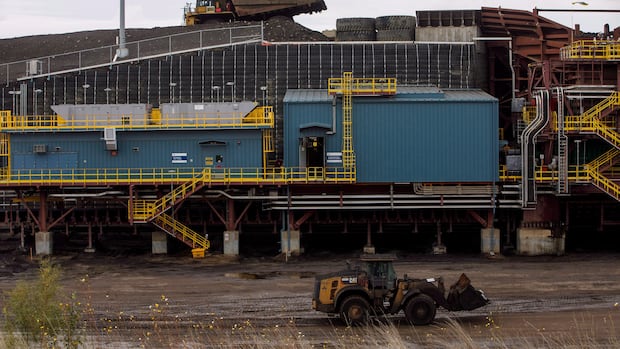

Alberta’s oilsands have experienced a relatively calm decade, but both federal and provincial authorities are optimistic that a new pipeline to the West Coast, combined with policy changes, could reignite activity.
This week, Prime Minister Mark Carney visited Fort McMurray, Alberta, to unveil the first project to be recognized as being in the national interest under legislation enacted last year: the Pacific Link pipeline, which aims to transport a million barrels of oil a day from Alberta to a tanker terminal in southern British Columbia.
This designation allows for a faster review process, overseen by the Calgary-based major projects office.
The success of the pipeline relies on oilsands companies’ readiness to invest in increasing their production capabilities. During a press conference, Carney was inquired whether he anticipated a resurgence of boom times in the northeastern Alberta oilsands hub.
“I wouldn’t characterize it as a ‘boom,'” he responded. “Rather, I would describe it as ‘sustained growth.'”
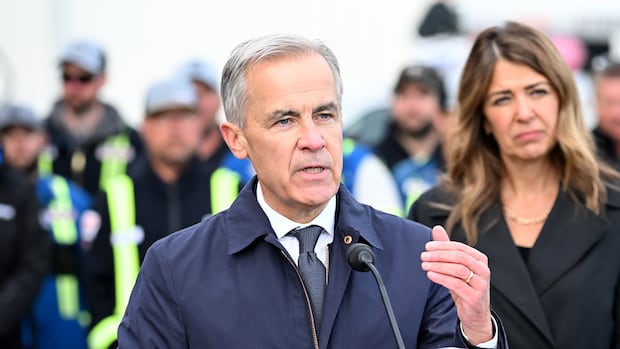
Prime Minister Mark Carney announced that the West Coast Pipeline, known as Pacific Link, will be listed as a project of national interest under the Building Canada Act, allowing the government to fast-track the approval process.
The last significant boom, occurring from the mid-2000s to the mid-2010s, resulted in challenges such as rising costs, labor shortages, and housing crises. Carney and Alberta Premier Danielle Smith suggest that if oilsands companies resume construction — which is their hope — things will be different this time.
For years, oilsands companies have been hesitant to undertake the multibillion-dollar megaprojects typical over a decade ago. The last new mine developed from the ground up was Fort Hills, managed by Suncor Energy Inc.
After receiving its final approval in 2013 and commencing operations in 2018, its costs surged from $13.5 billion to over $17 billion.
Recently, rather than embarking on “green field” projects, companies have opted to enhance their current operations to extract more bitumen or expand their existing sites.
Executives have pointed to limited pipeline capacity, a complex regulatory system, and strict environmental laws as reasons for the slowdown in large-scale growth initiatives.
[Companies] have managed to find a way to increase production without having the kind of dramatic pressure that we saw in the past of a large number of people moving here, not able to find homes.Danielle Smith, Alberta premier
However, around the time investment declined a decade ago, global oil prices plummeted due to an oversupply and did not have the opportunity to recover before the COVID-19 pandemic severely impacted demand.
Now, looking ahead to 2026, the conflict in the Middle East has exposed the fragility of global energy supply chains, prompting nations to seek reliable suppliers.
Several energy policies from the Trudeau administration, which were unpopular among oil industry stakeholders, have been reversed, and the Pacific Link pipeline has progressed significantly toward realization, potentially allowing more oilsands crude to access lucrative markets in Asia.
“We have learned valuable lessons from past infrastructure projects,” Carney told the media on Thursday.
He noted that local mayors are proactively considering their communities’ needs and that early engagement with First Nations leaders signifies “a much broader distribution of economic benefits.”
He also mentioned “another wave of technological advancement” in the industry that was previously absent.
A more mature oil sector
During the press briefing, Smith highlighted the autonomous haul trucks in operation nearby.
In the past, human operators for these massive vehicles would have earned six-figure salaries and often been flown in from other parts of Canada, residing in work camps for weeks at a time.
“[Companies] have managed to find a way to increase production without having the kind of dramatic pressure that we saw in the past of a large number of people moving here, not able to find homes,” Smith stated.
The premier mentioned her discussions with local municipal leaders regarding the necessary bridge and road infrastructure that might be required if production increases.
She noted the need for improvements to Highway 881, which runs through several steam-driven oilsands operations south of Fort McMurray.
“There are many opportunities for collaboration with the federal government to ensure these vital infrastructure projects are completed, allowing us to grow at a pace that keeps up,” she remarked.
Andrew Botterill, who oversees Deloitte Canada’s oil, gas, and chemicals practice, pointed out that the Alberta oil sector has evolved since the last boom.
“What we have now is a more efficient and better-coordinated group of producers than what existed 10 or 15 years ago,” he stated.
“They have formed an alliance and truly understand that ‘We need to share labor, reduce competition, and collaborate to manage costs effectively.'”

After months of discussions, a new proposed oil pipeline to the west coast has been named, mapped, and received backing from the federal government. The Pacific Link has been designated a “Project of National Interest” and aims to transport up to one million barrels of oil daily from Alberta to the B.C. coast, largely along the existing Trans Mountain corridor. CBC business reporter Kyle Bakx provides the latest updates.
Oilsands assets are now held by fewer companies than was the case a decade or more ago. Former producers such as Husky and MEG Energy have been acquired, while international firms like Shell and Total have scaled back or exited their investments.
Lance Mortlock, managing partner at EY Canada, raised a broader concern: With several significant projects underway — not just the Pacific Link pipeline and new oilsands initiatives, but potentially new mines, transmission lines, and hydroelectric dams — will there be an adequate workforce?
“We will require tens of thousands of workers nationwide to construct these projects: engineers, professionals, welders, and pipefitters. I am uncertain where all these individuals will come from if we pursue even half of the desired projects,” he noted.
“Thus, I hope there will be increased dialogue regarding the workforce and discussions on how to sequence these projects to optimize labor resources.”