
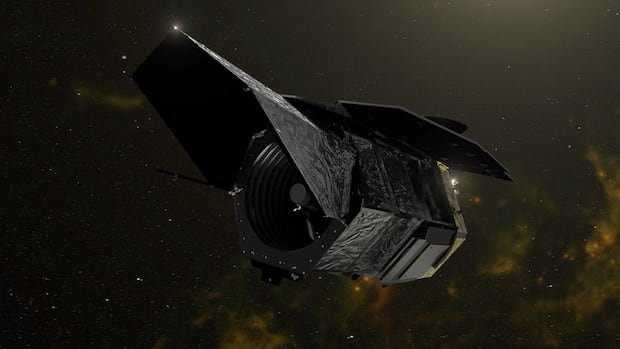

At 7:26 a.m. on Sunday morning, a new space telescope is set to launch from Cape Canaveral, Fla., atop a Falcon Heavy rocket. The Nancy Grace Roman Space Telescope, named after NASA’s first chief astronomer, is poised to uncover fresh insights about the universe. The telescope will be positioned 1.5 million kilometers away at a gravitational balance point called L2, ensuring a stable orbit. This five-year mission offers potential for extension.
The Nancy Grace Roman Space Telescope stands out among existing telescopes like the Hubble Space Telescope and the James Webb Space Telescope due to its unique features. It boasts a 2.4-meter mirror similar to Hubble but also includes a coronagraph for blocking starlight to detect planets orbiting distant stars. Additionally, its Wide Field Instrument matches Hubble’s sensitivity but can image areas 100 times larger, providing a significant enhancement in observation capabilities.
Equipped to resolve billions of stars, the telescope will facilitate various sky and stellar surveys. The telescope’s innovative instruments are expected to make groundbreaking discoveries, including advancements in exoplanet research. Scientists are eager to explore other planetary systems to unravel the mysteries of our solar system’s uniqueness.
The Nancy Grace Roman Space Telescope will utilize the transit method, akin to the Kepler Space Telescope, to detect exoplanets by observing the slight decrease in starlight when a planet passes in front of its host star. This mission is anticipated to expand our exoplanet knowledge significantly, with the capacity to observe a vast number of stars and identify numerous transiting exoplanets. Additionally, the telescope will employ the microlensing technique to delve deeper into the search for Earth-like planets.
Beyond exoplanet exploration, the telescope will focus on investigating dark matter and dark energy, which together constitute a substantial portion of the universe’s composition. Scientists aim to understand the elusive nature of dark matter, responsible for galactic cohesion, and dark energy, driving the universe’s expansion. The mission will survey galaxies and globular clusters to map out the distribution of dark matter and explore the effects of dark energy on the universe’s evolution.
The Nancy Grace Roman Space Telescope’s comprehensive capabilities are expected to shed light on fundamental cosmic questions, offering new insights into the universe’s mysteries.