
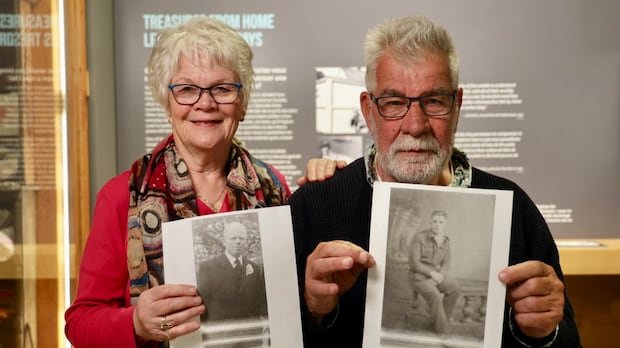

When Dina Van Dommelen-Samson and Nico Peltenburg first crossed paths earlier this month, it felt more like a long-lost family reunion than a meeting between strangers.
“He gazed at me, opened his arms, and I did the same. We shared a tearful moment and embraced tightly,” Van Dommelen-Samson recounted emotionally.
Peltenburg, visiting Nova Scotia with his family, sought to connect with the family of the man who sheltered his father, Jan Peltenburg, during the German occupation of the Netherlands in World War II.
“To think that a humble individual aided others in the war against Germany,” reflected Nico Peltenburg in Halifax.
“[Johannes Van Dommelen] didn’t know my father, yet he welcomed him into his home, ensuring his safety.”
Van Dommelen-Samson and Peltenburg recently recounted to CBC News the extraordinary tale of how the benevolence of strangers like Johannes Van Dommelen rescued Jan Peltenburg and his two brothers from being sent back to labor camps.
On June 2, 1943, the three Peltenburg brothers, all skilled carpenters, were ordered to report to an internment camp in North Holland before facing transfer to Berlin for service in Organization Todt, a paramilitary group utilizing forced labor to support wartime operations.
Peltenburg disclosed that his father and one uncle were eventually dispatched to a forced labor camp in Finland for approximately eight months, while the third brother was sent to Estonia and Lithuania.
Residents in the labor camps endured harsh conditions, including lice infestations, overcrowded living quarters, and food shortages, as detailed by Julie Thomas, chief curator at the Army Museum Halifax.
Thomas highlighted that inmates could earn time off through good conduct.
On April 10, 1944, the Peltenburg brothers were granted leave with the condition to return to work after three weeks, a condition they defied.
Instead, as Peltenburg narrated, the brothers fled to Brabant in southern Netherlands, where churches and members of the Dutch resistance arranged for families to conceal them in the village of Erp.
The brothers were separated, with Jan Peltenburg finding refuge on the Van Dommelen family farm, where he remained until the liberation of the Netherlands in 1945.
After their return to Schoonhoven, Jan Peltenburg occasionally revisited the Van Dommelen farm before the family migrated to Cape Breton in the mid-1950s.
Nico Peltenburg mentioned that his father passed away later that decade, his health deteriorating from the labor camp ordeal in Finland.
The two families did not reconnect until 2021 when one of Jan Peltenburg’s sons reached out to Van Dommelen-Samson to inquire about the family that sheltered his father during the war.
Van Dommelen-Samson, who was a toddler when her family relocated to Nova Scotia, initially had doubts about the connection, awaiting confirmation from her siblings.
While seeking validation, she requested a photo of Jan Peltenburg, which evoked a powerful reaction as she recognized the image from her childhood home’s family photo collection.
A profound bond, both new and familiar, has emerged some seven decades after their families parted ways.
“We’ve truly bonded like siblings because we share our parents’ stories,” expressed Van Dommelen-Samson.
“I believe they are watching over us and chuckling at the time it took for us to reunite.”