

Doreen Edna Buhler, who passed away at the age of 96, led a challenging yet extraordinary life. Following her father’s death, she departed from her birthplace in Calahoo, Alta., and established a new life in Edmonton, where she worked with her husband at his family’s diner. As a widow at 39, she relied on her faith to support her 13 children by working as a baker, pastry chef, and cook in various kitchens across the city.
Prior to her passing, Buhler made a significant decision to donate her body to the University of Alberta’s Anatomical Gifts Program, allowing future medical professionals to benefit from the body that had carried her throughout her life. At a commemorative service for anatomical donors at the university, her daughter Brigid Burton fondly described her mother as “incredible” and highlighted the additional chapter her donation represented.
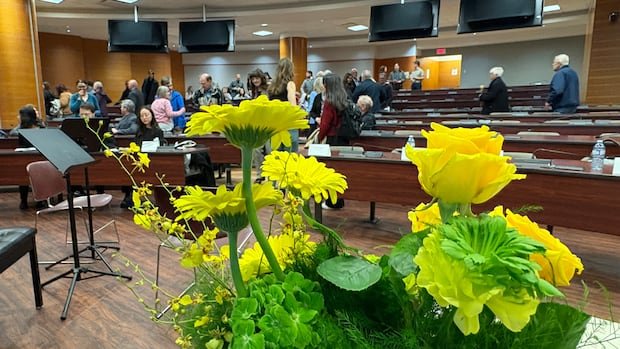
The annual memorial, held by the Faculty of Medicine & Dentistry, brought together students and faculty to honor those who had bequeathed their bodies to the program. Donor names were announced, followed by a moment of silence and the presentation of fresh-cut yellow roses to families. Dr. David Williams expressed gratitude to donor families for honoring their loved ones’ wishes and contributing to the education of numerous medical students each year.
Anatomical donations play a crucial role in various health and research programs at the university, including medicine, dentistry, kinesiology, physical therapy, and physical education. Buhler’s children, Brigid Burton and Anthony Buhler, shared that their mother had long expressed her intention to donate her body before her passing.
Buhler’s life was marked by resilience and faith, with her children viewing her act of donation as a reflection of the generosity and selflessness she embodied. Following the completion of her donation, her ashes will be laid to rest beside her husband, bringing closure to her remarkable legacy.
The University of Alberta’s Anatomical Gifts Program, in operation since the inception of the medical school in 1921, receives between 50 and 80 donations annually. Coordinator Jason Papirny noted that the program serves as a unique opportunity for individuals to continue teaching even after their passing, with donors from various backgrounds contributing to medical education.
The donated bodies offer students a hands-on understanding of anatomical relationships, disease progression, and rare medical procedures over a period of one to two years. Donors have the option to have their remains returned to their families or to be cremated and scattered at a designated plot at Westlawn Funeral Home Cemetery in Edmonton.
Margaret Juryn, a second-year medical student, emphasized the invaluable educational experience gained from training with real human bodies, highlighting the unique insights into individual life stories that textbooks cannot provide. She expressed admiration for the courage exhibited by donors and their families in making the vulnerable decision to entrust their remains for educational purposes.