
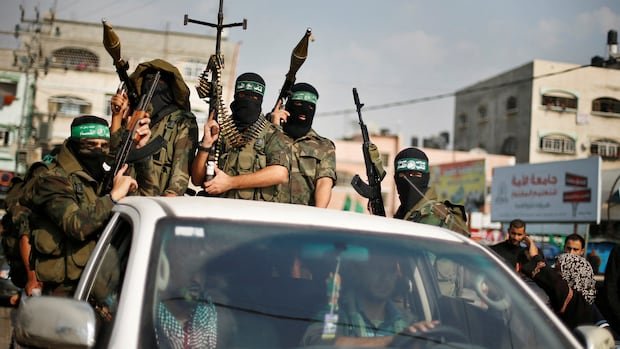

Israel has expressed significant security apprehensions to the White House regarding the proposed disarmament pact with Hamas, as per an Israeli official’s statement on Sunday. These remarks by Doron Spielman, the spokesperson for the Israeli Prime Minister’s office, represent one of the initial public comments following the announcement of the agreement by U.S. President Donald Trump.
According to Spielman, Israel’s intelligence evaluation indicates that Hamas is focused on rebuilding its military rather than genuinely disarming. He emphasized that the Israeli military would not retreat from Gaza, where it holds authority over more than 60% of the region, until Hamas relinquishes its weapons.
Spielman stressed the importance of Hamas physically surrendering its weapons for genuine disarmament, stating that anything less would not suffice. This statement follows Hamas’ recent declaration of willingness to disarm as part of the ceasefire brokered by the U.S. nine months ago to end the protracted conflict. While this signals a potential breakthrough, numerous obstacles, terms, and extended timelines must be navigated.
Trump’s 20-point ceasefire proposal outlines the requirement for the militant group to hand over its weapons and dismantle its extensive tunnel network. The plan also envisions the withdrawal of Israeli forces from Gaza, the establishment of a new Palestinian government, the deployment of an international security force, and the reconstruction of the war-ravaged Palestinian enclave.
The issue of Hamas disarmament has been a sticking point impeding negotiations for several months. Trump, in unveiling the deal on social media, mentioned that it would be executed in carefully structured phases.
As per a verified copy of the agreement obtained by the AP, all weapons under the control of the Hamas-led police will be transferred to the U.S.-backed Palestinian technocratic committee upon its arrival in Gaza. The process of decommissioning heavy weapons, dismantling military production sites and tunnels, will commence post the arrival of the Palestinian committee and international forces. This process will be coordinated with a phased Israeli withdrawal, as stipulated in the agreement.
In Gaza, the areas controlled by Israel have suffered extensive destruction and depopulation. The majority of the territory’s two million Palestinians reside in the other section, with many living in poor conditions in tent camps and ruined neighborhoods.
Given the upcoming elections in October, Israel is unlikely to pull back substantial forces or make concessions. Prime Minister Benjamin Netanyahu faces a challenging re-election campaign, with pressure from his far-right coalition allies to maintain a tough stance on Hamas and retain forces in Gaza. Critics accuse him of failing to prevent the 2023 attack that led to a significant loss of lives.
During the 2023 attack, Hamas-led militants targeted Israeli communities, resulting in casualties and hostages. In response, Israel launched a military offensive that inflicted casualties on both sides.
Despite acknowledging Trump’s dedication to Israel’s security and conflict resolution, Israel’s stance on disarmament is rooted in intelligence reports indicating Hamas’ ongoing military buildup efforts. The specifics of Israel’s concerns conveyed to the White House are unclear, but sources suggest communication with former British Prime Minister Tony Blair, a member of the Trump-led Board of Peace, addressing the need for operational freedom in Gaza.
Since the ceasefire agreement, Israel has maintained strikes on Gaza, citing targeting of Hamas and its infrastructure. Recent strikes have resulted in casualties, including children, with the Israeli military claiming to have targeted Hamas military personnel during these operations.