
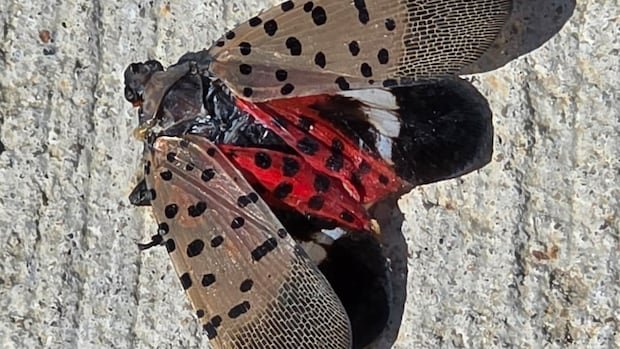

An invasive insect that is destructive to grapevines and other crops and trees has been found in Canada for the first time by the Canadian Food Inspection Agency (CFIA), with the initial detection occurring in Windsor.
Windsor residents had previously reported sightings of the spotted lanternfly, as stated by a non-profit organization dedicated to preventing the spread of invasive species. However, this recent detection marks the first time it has been identified through an agency survey, according to the Invasive Species Centre.
The spotted lanternfly is infamous for causing harm to grapevines, leading to significant consequences for the grape and wine industry, as highlighted in a news release by the centre. Additionally, this pest has the potential to impact other agricultural sectors, horticulture, forestry, residential areas, and community parks. If left unchecked, the spotted lanternfly could bring about extensive economic, ecological, and social repercussions.
Originally from southeast Asia, the spotted lanternfly was first sighted in North America in Pennsylvania back in 2014. This insect has a wide-ranging diet, feeding on the sap of more than 100 plant species.
To combat the spread of the spotted lanternfly, the centre urges the public to educate themselves on identifying the insect. In case of observing the fly or its eggs, individuals are advised to capture them, seal them in a plastic bag or container, and report the finding to the CFIA promptly.
For proper identification of a spotted lanternfly, the Invasive Species Centre and CFIA offer the following tips:
– Adults are approximately 25mm long and 12mm wide, with distinctive brown/grey wings and red rear wings.
– Nymphs come in black and white or red with black and white spots.
– Egg masses can be found on trees and surfaces, resembling grey smears or rows of seeds.
The insect’s excrement, known as honeydew, can attract bees and wasps while fostering the growth of sooty mold at the base of host trees.
To prevent the spread of the spotted lanternfly, individuals are advised to thoroughly inspect their belongings when visiting areas with known infestations, consider washing vehicles regularly, and avoid transporting firewood from one place to another.