
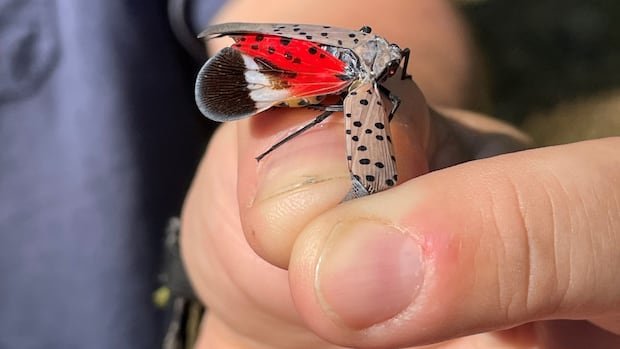

A recent study conducted at the Great Lakes Forestry Centre in Sault Ste. Marie, Ont., has brought to light fresh concerns regarding an invasive insect edging closer to the Canadian border. According to Amanda Roe, a research scientist with Natural Resources Canada stationed at the forestry centre, the research indicates that the spotted lanternfly, especially its eggs, can endure extremely cold temperatures, with findings showing their survival capability at temperatures as low as -25°C. This discovery suggests that the winter season may not be a sufficient deterrent to prevent the harmful pest from establishing populations in various parts of Canada.
The spotted lanternfly, a destructive sap-sucking insect native to Asia, uses straw-like mouthparts to puncture trees and plants, extracting sap. Initially discovered in the United States in 2014, the insect has swiftly expanded across the eastern U.S. and settled in at least 19 states, including Michigan and New York, as well as communities along Lake Erie.
Olivier Morin, a plant health survey biologist at the Canadian Food Inspection Agency, highlighted that the insect feeds on over 100 plant species, with grape productions anticipated to be significantly impacted. In infested regions of the United States, the spotted lanternflies have caused notable issues for vineyards and agricultural activities. The insect’s large numbers feeding on plants can reduce yields, weaken crops, and lead to the production of honeydew, a sugary waste that promotes mold growth.
Apart from grapes, the insect also targets maple trees, raising concerns within Canada’s maple syrup industry. The Ontario Maple Syrup Association has been vigilantly monitoring the spotted lanternfly for the past three years to understand better the risks it poses.
Despite current studies shedding light on the insect’s cold tolerance, Amanda Roe stressed that invasive species can adapt to new environments over time, emphasizing the ongoing uncertainty regarding the northern boundary of the spotted lanternfly. Human activities play a significant role in the insect’s spread, as it is adept at hitchhiking on vehicles, cargo, and outdoor equipment, with females laying egg masses on various surfaces.
The Canadian Food Inspection Agency has intercepted spotted lanternflies on cargo shipments, vessels, and vehicles arriving from the United States, indicating a looming threat. Individuals encountering a spotted lanternfly are advised to photograph the insect, if possible, collect it in a sealed container, and report it to the Canadian Food Inspection Agency.
In conclusion, while efforts are being made to impede the spread of the spotted lanternfly into Canada, the authorities anticipate its arrival and aim to minimize its impact as much as possible.