
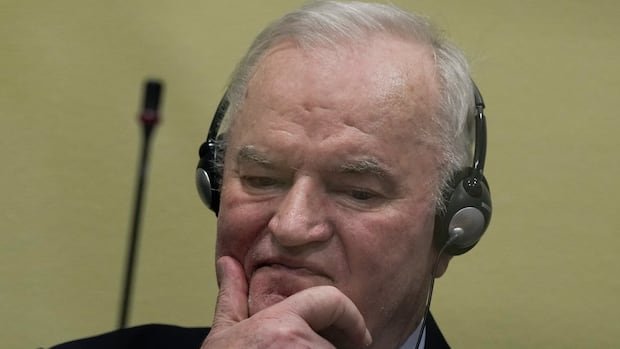

Ratko Mladic, who was found guilty of genocide for masterminding the 1995 massacre of over 8,000 Muslims in Europe’s deadliest atrocity since World War II, has passed away.
According to his attorney Dragan Ivetic, Mladic died while in UN custody on Thursday, with the cause of death undisclosed. In his final months, the former general was confined to the hospital wing of the UN detention facility located in a suburb of The Hague.
The brutal events in Srebrenica marked the climax of a conflict spanning more than three years, during which Mladic relentlessly bombarded the besieged Sarajevo with artillery, tanks, mortars, and heavy gunfire, resulting in the deaths of 10,000 individuals.
The victims from Srebrenica were hastily buried in mass graves over a period of four days in July 1995, with some remains later relocated to remote mountains to conceal evidence of the atrocities committed.
The United Nations International Criminal Tribunal for the former Yugoslavia (ICTY) determined that the objective behind these actions was “ethnic cleansing,” aimed at expelling Bosnian Muslims, Croats, and other non-Serbs to establish a Greater Serbia.
The tribunal concluded that Mladic, along with Serbian President Slobodan Milosevic and Bosnian Serb political leader Radovan Karadzic, were part of a criminal enterprise to execute this plan.
During a hearing at the ICTY in 2014, Mladic, known as the “Butcher of Bosnia,” declared that he did not acknowledge the court. Upon receiving a life sentence in 2017, he vehemently protested, denouncing the verdict as fabricated.
Karadzic, also convicted of genocide in 2016, and Mladic were long sought by the ICTY following the conclusion of the conflict by Western powers. Mladic resided discreetly in Belgrade until the popular uprising that ousted Milosevic in 2000.
Mladic’s military tactics in Bosnia exemplified extreme ruthlessness, with prisoners subjected to inhumane conditions such as forced salt intake leading to suffocation, starvation, rape, and mass shootings, among other atrocities.
Munira Subasic, who lost her son and husband to Bosnian Serb forces in Srebrenica, described Mladic as a symbol of the war’s atrocities, including rape and murder targeting Muslims.
Mladic infamously filmed the assault on Srebrenica, berating Dutch UN peacekeepers who trusted his false promises of safety for the town’s residents. Despite being designated a “safe area,” Srebrenica fell victim to ethnic cleansing under Mladic’s command.
In 1995, when NATO attempted to restrain his forces through threats of airstrikes, Mladic’s troops retaliated by using UN peacekeepers as human shields, tethering them to potential targets.
After intense pressure, Mladic stepped down from his position in November 1996, as demanded by Bosnian Serb President Biljana Plavsic, who later faced imprisonment for her involvement in war crimes.
Born in 1943, Mladic served as an officer in the Yugoslav People’s Army (JNA) during the country’s dissolution in 1991. He assumed command of the Bosnian Serb army during the uprising against Bosnia’s Muslim-led secession in 1992, leading to widespread violence and destruction.
Despite appeals from the West, Serbia’s post-Milosevic leadership refrained from taking action against Mladic, who remained a revered figure among nationalist Serbs.
Finally apprehended in 2011, Mladic offered no resistance and appeared frail, suffering from health issues like a paralyzed arm and a heart attack in subsequent years. His appeal against conviction was rejected in 2021, along with multiple pleas for compassionate release.