
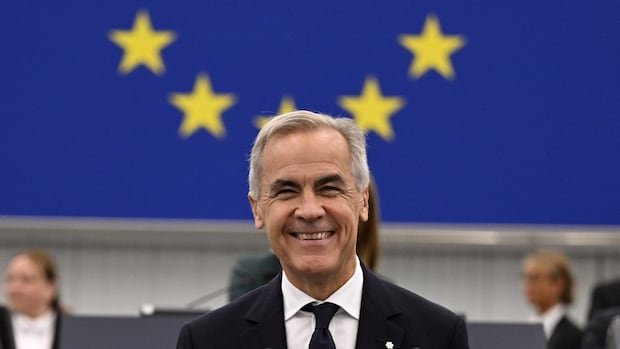

Prime Minister Mark Carney and European Commission President Ursula von der Leyen delivered speeches this week outlining a new partnership between Canada and the EU. However, many details are still being discussed and finalized.
The proposal suggests Canada could become the EU’s inaugural “associate member” or what Carney terms as “an alliance for the future.” Carney has emphasized that Canada is not seeking full EU membership. During his address to the European Parliament in Strasbourg, he expressed support for von der Leyen’s proposal.
The concept of an ‘associate’ member is not clearly defined at this stage. While the term is not legally binding, various models of associate-type relationships have been proposed in the past. A Canadian official revealed that the label of “associate member” is just one of several options under consideration, and it was not Canada’s proposal.
Von der Leyen highlighted the EU’s intention to elevate its partnership with Canada to the highest level possible. The discussions encompass collaboration in areas such as manufacturing, technology, defense, the Arctic, energy, and security.
Carney outlined specific aspects of the envisioned partnership, including cooperation in critical minerals, defense industrial capacity, AI, energy security, space, and payments. He also mentioned the potential for Canadian participation in the EU’s Erasmus+ program for education and Horizon research and innovation funding.
The EU and Canada have existing agreements like the Comprehensive Economic and Trade Agreement (CETA) and strategic partnerships in various sectors. Carney clarified that the proposed alliance is not about creating a great-power rivalry but aims to set an example for other democracies.
Concrete details are expected to be discussed further at a Canada-EU summit in Montreal in October. Yet, uncertainties remain, including the agreement’s name, potential concessions from Canada, mobility changes, and the need for approval from EU member states and the Canadian Parliament.
Carney confirmed that Parliament will scrutinize and vote on the alliance’s structure with the EU. While concerns have been raised by some EU diplomats about the proposal’s lack of prior discussion with member states, the formalization of an “associate member” status in EU treaties would require unanimous agreement and domestic ratification from all 27 countries.
Even the long-standing Canada-EU free trade agreement is not fully implemented in all EU countries, underscoring the complexities involved in international partnerships.