
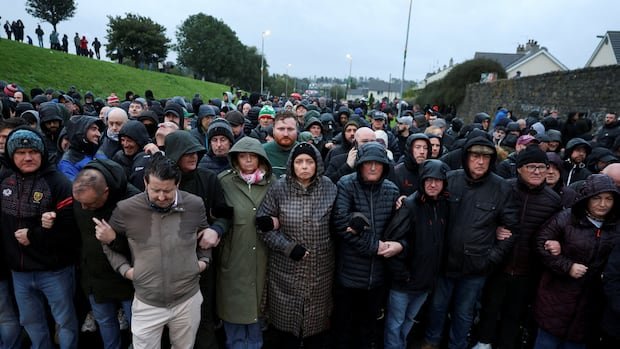

British Prime Minister Andy Burnham has urged for peace in Northern Ireland following a controversial parade that was permitted by the High Court in Belfast during a late-night session. Demonstrators, many masked, gathered to obstruct the Orange Order marchers in Portadown, a town where preferences for unification with the Republic of Ireland are strong.
This marks the first time in nearly three decades that the Orange Order parade has been sanctioned to proceed down the Garvaghy Road, a historically contentious spot that was a focal point of conflict before the 1998 Good Friday Agreement brought relative peace to Northern Ireland after years of violence that claimed thousands of lives.
The resolution of the Troubles involved managing the conflicting identities in Northern Ireland, where a significant portion of the population, mainly Catholic Irish nationalists, seeks unity with the Republic of Ireland, while many Protestant unionists desire to maintain ties with the United Kingdom.
Burnham has called for restraint from all sides, emphasizing the progress made in Northern Ireland and the need to avoid regression. Jon Boutcher, the head of the Police Service of Northern Ireland, has appealed to influential figures to promote compliance with the law amid a large protest on the Garvaghy Road, noting the absence of violence or disorder.
Divergent opinions among politicians representing the two factions have emerged regarding the legitimacy of the parade. Northern Ireland First Minister Michelle O’Neill, affiliated with Sinn Fein, critiqued the approval of the march, questioning the efficacy of the peace process, while attending the counter-protest.
Gavin Robinson, leader of the Democrat Unionist Party, criticized Sinn Fein leaders for exacerbating tensions, stressing the importance of upholding the rule of law and respecting institutions. The Orange Order procession received final clearance during a predawn court session on Sunday.
The Orange Order, named after Protestant figure William of Orange, who secured the British throne in the 17th century by defeating Catholic King James, holds significance in Northern Ireland’s historical and cultural context.