
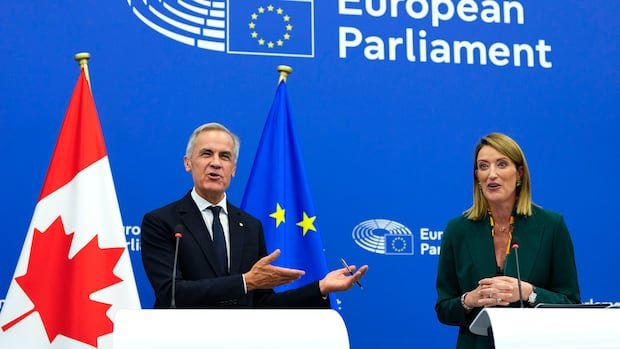

Canada and the European Union are enhancing their relationship, with Prime Minister Mark Carney expressing keen interest in participating in Erasmus+, a popular exchange program in Europe. While many specifics of this potential collaboration remain to be clarified, such as the implications of being the EU’s first “associate member,” Carney advocated for Canadian involvement in Erasmus+ during a speech at the European Parliament in Strasbourg, France.
Carney emphasized that Canada is not pursuing full EU membership and highlighted the need for a distinct framework for the proposed partnership. He also showed enthusiasm for engaging in the upcoming version of Horizon, Europe’s research and innovation funding program, in which Canada is already engaged. The current Horizon program for 2021-2027 has a funding allocation exceeding $140 billion.
European Parliament President Roberta Metsola, speaking alongside Carney, expressed optimism about the potential for enhanced cooperation with allies like Canada. Metsola highlighted Erasmus as a primary association European youth make with the EU, followed by Horizon as a key opportunity for collaboration with Canada.
Although details regarding Canada’s participation in Erasmus+ are yet to be determined, the recent agreement of the United Kingdom to join the program without EU membership could serve as a model. The U.K. recently entered a temporary agreement to participate in Erasmus+, committing £570 million (over $1 billion Cdn) to the program in 2027.
Erasmus, established in 1987 and later expanded as Erasmus+, allows individuals to study and train at various European institutions for up to a year. Initially focused on university exchanges, the program now encompasses work experience, apprenticeships, and sports exchanges. Over 16 million individuals have benefited from the program since its inception, with an increased budget of €28.5 billion for 2021-2027. Erasmus+ includes not only EU member states but also other countries like Norway, Iceland, and the U.K.