
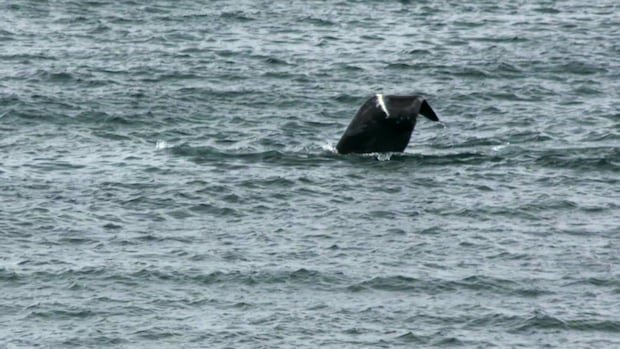

Heather MacAulay and her spouse, Chris Murphy, were puzzled by an unusual sight in the waters near Blackhead Cove in Conception Bay North this week. MacAulay described the creature as a large, misshapen entity with a vertical tail that seemed to be injured, remarking on its distinctiveness. She expressed her fascination with the first-time sighting to Paula Gale, host and producer of The Broadcast on CBC Radio.
They had encountered a rare North Atlantic right whale, a critically endangered species with only about 384 individuals left. MacAulay’s neighbor, Alex Cole, affiliated with the Canadian Wildlife Federation and the Atlantic Right Whale Project, verified the sighting. The Department of Fisheries and Oceans (DFO) also confirmed the whale’s identity as a right whale based on its markings.
The whale is suspected to be the calf of Checkmark 3705, a right whale initially seen in Florida with its calf last year. MacAulay and Murphy, who reside in Nova Scotia but have a summer home in Blackhead, have developed a keen interest in right whales. DFO informed them that the same whale was spotted earlier this year in Massachusetts.
While the right whale was present in Blackhead, Broad Cove on September 1, MacAulay had not seen it again by the time of her interview with CBC on September 3. They are actively monitoring social media to track the whale’s movements for another potential encounter and further observation.
Alex Cole mentioned that sighting right whales off the east coast of Newfoundland is not uncommon, occurring every few years. However, these whales are known to frequent the southern Gulf of St. Lawrence. Despite a previous decline in population around 2010, the numbers seem to have stabilized. Any sighting of a right whale is considered valuable for researchers to understand their habitat preferences.
Concerns arose regarding a potential local fishing ban following the whale sighting. However, DFO clarified that no such prohibition was necessary and urged caution from harvesters. The primary threats to the right whale population are entanglement in fishing nets and vessel collisions, contributing equally to mortality risks.
MacAulay observed damage to the right whale’s tail, speculating it could be a shark bite, while Cole suggested it might be from a vessel interaction. Cole emphasized the importance of using protective fishing technology to prevent such incidents, emphasizing ongoing efforts to enhance whale conservation practices.
The conservation status of the right whale population shows some positive signs, with recent calf births indicating potential recovery in the coming years. Researchers stress the significance of reporting whale sightings to aid in species recovery efforts.