
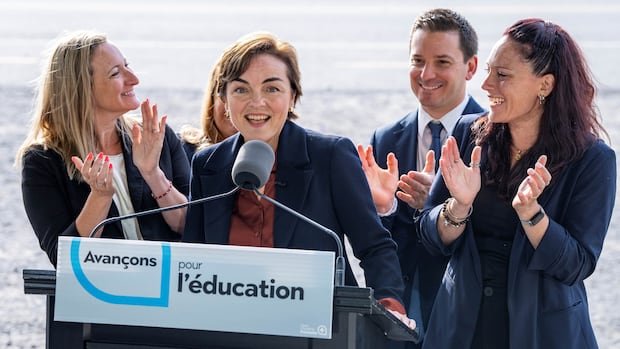

Last week, the leader of the Coalition Avenir Québec, Christine Fréchette, made an education-related announcement in front of a newly built high school in Saint-Zotique, Quebec. While she pledged to invest $1,000 in the Registered Education Savings Plan (RESP) for every Quebec-born child, it was her stance on the province’s education system that captured attention.
When asked about the existence of a three-tier system in Quebec, Fréchette responded, “Not really.” This system encompasses subsidized private schools, public schools offering specialized programs, and regular public schools. Her remarks followed the release of a report by Montreal public health officials, which criticized the system for exacerbating health inequalities among young people in the city.
The disparities highlighted in the report show significant differences between private and public school students, as well as within the public system itself, particularly concerning access to specialized programs. Dr. Mylène Drouin, the head of Montreal Public Health, emphasized that students facing academic challenges and coming from disadvantaged backgrounds are disproportionately affected by these inequalities.
Data from the report for 2023-24 revealed a notable gap in graduation and qualification rates between students in private schools (92.5%) and those in the public system (79.8%). Moreover, students from more advantaged socioeconomic backgrounds demonstrated higher success rates compared to their less privileged counterparts.
The report emphasized various aspects such as school experience, self-esteem, and health habits, indicating that public school students encounter more significant health challenges than those in private schools. Factors like lower self-esteem, higher mental health diagnoses, and less active lifestyles were prevalent among public school students, contributing to a higher dropout risk.
Christine Fréchette’s comments sparked criticism from union leaders and Québec Solidaire, who accused her of being disconnected from reality. Québec Solidaire has advocated for the elimination of the three-tier system, pointing out that private school subsidies and selective programs perpetuate social segregation.
The call for a unified school system has been echoed by the Fédération autonome de l’enseignement (FAE), representing around 60,000 teachers, emphasizing the need for genuine societal reform in public education. The union urged for public funding for private schools to be contingent on collaboration or integration with the public system.
While the Parti Québécois has pledged to initiate a comprehensive consultation on education within its first 100 days in power, the Coalition Avenir Québec has opposed this idea, citing potential delays in necessary reforms. The debate surrounding the education system’s structure continues, with various parties expressing differing views on potential consultations.
In a parallel development, the federation of private schools in Quebec launched a campaign to underscore the importance of diverse educational pathways in catering to students’ needs. The campaign aims to dispel misconceptions surrounding private schools, emphasizing their role in complementing the public education system and accommodating students with special needs.