
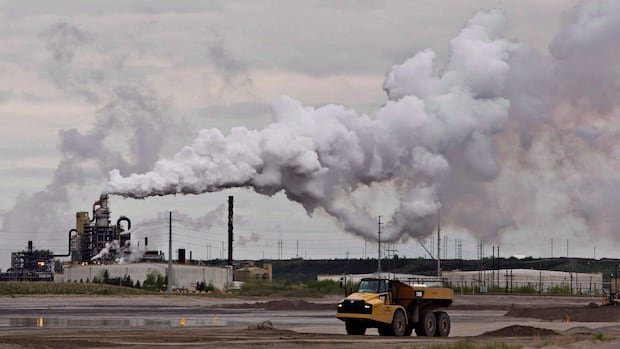

The Alberta government, Ottawa, and five major oil companies have reached an agreement to advance the Pathways Project, a multibillion-dollar initiative aimed at transporting and storing oilsands greenhouse gas emissions. This project is crucial for the progression of a proposed West Coast oilsands pipeline and is intended to mitigate some of the carbon dioxide emissions associated with the pipeline’s operations.
By committing to regulatory and fiscal measures that promote oilsands production growth, the governments aim to ensure the pipeline from Alberta to southern British Columbia can be utilized to its full capacity. The Pathways agreement, formalized on July 2 alongside Alberta’s pipeline proposal submission, signifies a significant step towards achieving common goals between the public and private sectors.
Alberta Premier Danielle Smith emphasized the importance of collaboration between governments and industry partners in realizing transformative projects that benefit the economy, enhance energy security, and create new opportunities for Canadians. The Pathways-pipeline agreement is part of a broader agreement signed between Ottawa and Alberta last November, focusing on various energy-related initiatives.
Under the agreement, the federal government has extended investment tax credits for carbon capture equipment and associated infrastructure to support emissions reduction efforts. Ottawa is also set to introduce legislation enabling investment tax credits for enhanced oil recovery operations, involving the injection of carbon dioxide into mature oil fields to boost production.
Alberta, on its part, has committed to establishing its own incentive program for carbon capture and providing financial support to stimulate oil production growth necessary for the West Coast oil pipeline and other pipeline expansions. The agreement also includes incentives for companies operating under Alberta’s carbon pricing framework, contingent on meeting specified targets.
The Pathways Project is scheduled to be implemented in stages, with infrastructure expected to be operational by January 1, 2032, and the project completed by 2035. The consortium responsible for the project, comprising Canadian Natural Resources, Imperial Oil, Suncor, Cenovus Energy, and ConocoPhillips, collectively known as the Oil Sands Alliance, expressed optimism about the framework’s potential to support industry growth and advance the Pathways Project.
The project involves a network of pipelines to transport captured carbon dioxide from northern Alberta oilsands sites to an underground storage facility near Cold Lake, Alberta. Initially estimated at $16.5 billion, the project’s cost projection has been revised to between $20 billion and $30 billion, as indicated by Cenovus CEO Jon McKenzie at an energy conference in June.
The Pathways Project aims to have the capacity to transport and store approximately six million tonnes of captured CO2 annually by the mid-2030s, with a target of achieving an additional 10 million tonnes of reductions by 2045. The agreement also highlights a commitment to prioritize the use of Canadian construction materials in the project’s development.
Future agreements between the federal and Alberta governments and each Oil Sands Alliance member are expected to be finalized by November 15, underscoring the commitment to advancing collaborative efforts towards sustainable energy solutions.