
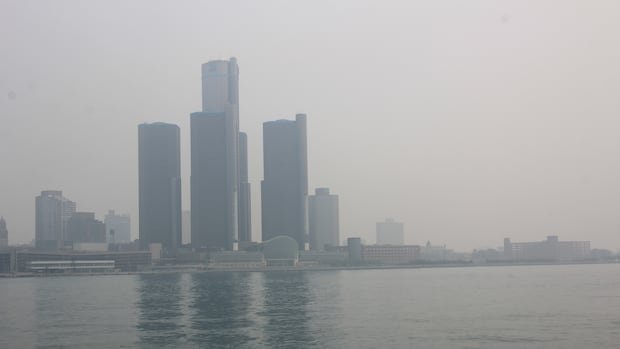

Michigan is enhancing its communication of air quality risks following the impact of Canadian wildfires on Detroit in 2023 and 2025. Jim Haywood, a senior meteorologist at the Michigan Department of Environment, Great Lakes, Energy (EGLE), stated that the state will now issue air quality alerts when fine particulate matter or ozone levels reach the “unhealthy for sensitive groups” category on the Air Quality Index. Previously, alerts were only issued when levels were forecasted to be in the “unhealthy” range, with advisories for the “orange” range.
Forecasting smoke conditions beyond a 24-to-48-hour window is challenging due to uncertainties in predicting the path of smoke traveling over long distances. Brian Wiens from Canada Wildfire mentioned that while there may be fewer fires in Canada this year, the onset of an El Niño weather pattern could heighten fire risks in western Canada. Drought conditions in various Canadian provinces have been alleviated by recent storms, but the potential for increased fire danger remains if El Niño conditions develop.
In the U.S., a severe fire season is anticipated in the western states due to widespread drought conditions. The National Interagency Fire Center’s outlook warns of significant fire potential in the south and southwest during April and May, with elevated wildfire risk in the west for June and July.
The National Oceanic and Atmospheric Administration attributes the rise in U.S. wildfires over the past two decades to climate change-induced heat and drought. Vulnerable populations such as children, pregnant individuals, and older adults are particularly at risk from the health effects of wildfire smoke, which contains harmful PM2.5 particles linked to respiratory and cardiovascular ailments.
To protect against wildfire smoke exposure, the Michigan Department of Health and Human Services recommends using air purifiers, running air conditioning with MERV-13 filters, creating clean indoor spaces, and wearing N95 or P100 respirators when outdoors in heavily polluted air. These measures can help mitigate the health risks associated with wildfire smoke inhalation.