
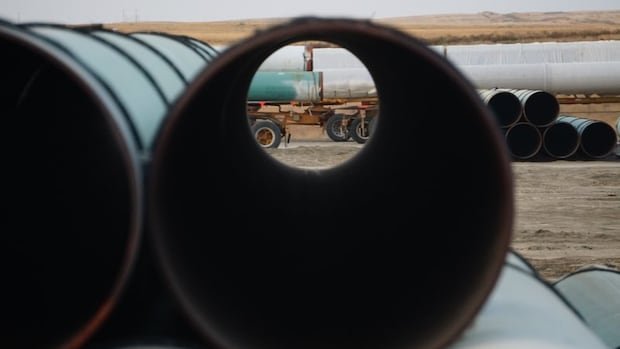

A plan put forth by South Bow, a Canadian company, aims to breathe new life into sections of the previously scrapped Keystone XL oil pipeline, potentially boosting Canada’s crude exports to the U.S. by over 12%. This endeavor hinges on approval from U.S. President Donald Trump and the construction of additional connections to U.S. refining centers.
The revised proposal outlines an alternate path through the U.S. compared to the original Keystone XL project, which was halted by former U.S. President Joe Biden in 2021 following prolonged opposition from Indigenous groups and environmental activists. South Bow, established by TC Energy in 2024 to manage its oil pipeline operations, is contemplating the revival of a portion of the pipeline already constructed in Alberta, having secured all necessary Canadian permits.
During discussions with Trump in October, Canadian Prime Minister Mark Carney broached the subject of reviving the pipeline, potentially leveraging it in forthcoming negotiations concerning the renewal of the Canada-U.S.-Mexico trade agreement (CUSMA).
South Bow is exploring a partnership with Bridger Pipeline in the U.S., as Bridger recently submitted a proposal to Montana regulators for a 1,038-kilometre pipeline capable of transporting up to 550,000 barrels per day. This pipeline would initiate near the U.S.-Canada border in Phillips County, Montana, and extend to Guernsey, Wyoming. However, analysts note that additional links would be necessary to transport the oil to key refining hubs such as Cushing, Oklahoma; Patoka, Illinois; and the U.S. Gulf Coast.
A viable configuration involves constructing a new pipeline spanning over 680 kilometers from Guernsey to Steele City, Nebraska, where it could connect to the existing Keystone mainline system, facilitating the transfer of oil to underutilized pipelines leading to Cushing, Patoka, and Wood River, Illinois. Nonetheless, the main challenge lies in obtaining permits and overcoming potential environmental litigation associated with the project.
While South Bow’s proposal differs from the previous Keystone XL initiative, it remains a significant pipeline expansion likely to draw opposition from environmentalists, landowners, and Indigenous communities. The proposal necessitates a presidential permit for the segment crossing the U.S.-Canada border, and the future of the project beyond the current administration remains uncertain.
In a parallel development, Enbridge, a rival of South Bow, has greenlit expansion projects for its Flanagan and Mainline pipeline systems, adding a combined 250,000 barrels per day of capacity for Canadian heavy oil shippers to reach U.S. markets. These projects are deemed less complex and more financially viable compared to South Bow’s proposal, raising concerns among investors about the latter’s funding capabilities without compromising dividends or incurring excessive debt.