
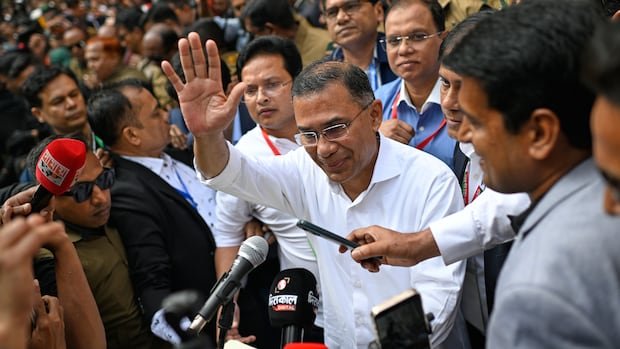

The Bangladesh Nationalist Party (BNP) has declared victory in the recent election, marking the first election in Bangladesh following the 2024 uprising. This win positions the BNP to lead the next government and potentially reshape the country’s political landscape after years of fierce rivalry and contested election results.
According to the party’s media unit statement on Friday, the BNP has reportedly secured enough parliamentary seats to govern independently, although the rival Jamaat-e-Islami group has expressed concerns over delayed result announcements. While the official final seat count from the Election Commission is pending, various local media sources have indicated that the BNP has surpassed the 151-seat threshold required for a majority in the 350-member parliament, which includes 50 reserved seats for women distributed proportionally among winning parties.
The Election Commission reported a voter turnout of 59.44% in Thursday’s election, with over 127 million eligible voters, nearly half of whom were women and 5 million first-time voters. The BNP, led by Tarique Rahman, a 60-year-old and the party’s prime ministerial candidate, returned to Bangladesh in December after 17 years in self-exile in London. He is the son of the late former Prime Minister Khaleda Zia.
Ruhul Kabir Rizvi, the senior joint secretary-general of the BNP, congratulated the people of Bangladesh on the electoral victory in a statement. Additionally, Saleh Shibly, press secretary to Rahman, announced that the BNP leader urged supporters to offer special prayers in conjunction with the weekly Friday service and refrain from organizing celebratory rallies and processions.
The U.S. Embassy in Dhaka, as well as leaders from India and Pakistan, extended congratulations to Rahman and his party on their victory. The U.S. Ambassador to Bangladesh, Brent T Christensen, hailed the win as a “historic victory” and expressed eagerness to collaborate for mutual prosperity and security. Indian Prime Minister Narendra Modi and Pakistan’s President Asif Ali Zardari also praised Rahman’s success and voiced commitments to strengthening democratic partnerships.
The election saw the Islamist Jamaat-e-Islami party making notable strides, securing at least 77 seats as part of an 11-party alliance. Although falling short of a majority, the alliance led by Jamaat-e-Islami asserted its impact on the political landscape. Shafiqur Rahman, the party’s leader, is set to become the opposition leader in Parliament, despite objections raised by the party regarding the election result handling.
The electoral process, held amidst stringent security measures, was viewed as a crucial test for Bangladesh’s democracy in light of recent political unrest and calls for reform. It also included a referendum on political reforms, such as prime ministerial term limits and enhanced executive power oversight, the results of which are pending but anticipated to be endorsed by voters.
Tarique Rahman’s return from exile marked a significant shift for the BNP, which had spent years in opposition, alleging electoral malpractice and political oppression under the previous government. The party’s history is deeply intertwined with Bangladesh’s political landscape, characterized by longstanding rivalries and power struggles.
While the BNP’s victory signifies a departure from past political dynamics, experts emphasize the need for the party to navigate challenges and demonstrate a commitment to democratic governance in the aftermath of the election.