
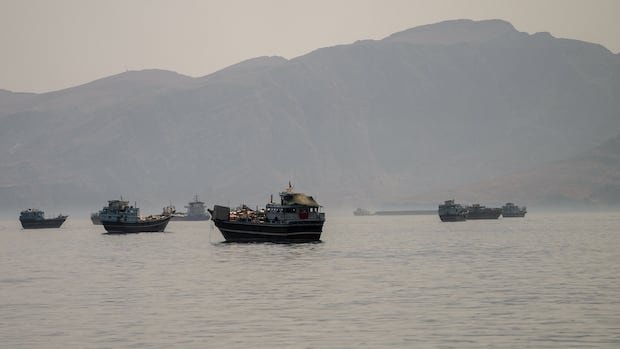

The status of the Strait of Hormuz is under debate as American and Iranian leaders offer conflicting accounts. While the U.S. asserts that the waterway is open to shipping traffic, Iran claims it has been closed once more. Approximately one-fifth of the world’s oil passes through this crucial strait.
Ian Ralby, a non-resident senior fellow at the Center for Maritime Security and CEO of consultancy firm I.R. Consilium, argues that the strait is not functionally open. According to him, the definition of “open” differs between the U.S. and the shipping industry, with the latter largely perceiving it as closed. Ship tracking data indicates that traffic through the strait has been minimal compared to pre-war levels.
Last week, the U.S. and Iran agreed to a 60-day ceasefire, allowing unrestricted passage for commercial vessels through the strait. However, the Iranian Islamic Revolutionary Guard Corps (IRGC) announced the closure of the strait on Saturday, citing alleged Israeli “crimes” in Lebanon and U.S. violations of ceasefire commitments. President Donald Trump assured that no toll would be imposed for strait passage during or after the ceasefire, unless peace talks fail. U.S. Central Command reported that 55 merchant ships transited the strait on Saturday, transporting significant cargo and over 17 million barrels of oil globally.
Ralby notes that before the U.S.-Israel conflict with Iran began on February 28, an average of 130 to 160 ships transited the strait daily in both directions. This number drastically decreased to about six ships per day after Iran initially closed the waterway, with some allowed to pass by paying tolls. Following the agreement to end hostilities, the number rose to 25 on Thursday.
Despite these developments, the IRGC’s announcement prompted marine radio broadcasts warning of restricted access without permission, with reports of warning shots being fired shared among shippers. Ralby highlights U.S. efforts to guide ships through the strait’s southern corridor via Omani waters, noting the presence of a sea mine in the area, heightening the risks for vessel operators.
Ships passing through the Iranian side likely obtained permission from Iran, as outlined in a memo from the Persian Gulf Strait Authority mandating ships to acquire passage permits for strait transit. Ralby questions the credibility of both sides, emphasizing that the current situation falls far short of returning to normalcy that could stabilize global markets.
Peace talks between the U.S. and Iran continued in Switzerland on Sunday, with Trump issuing warnings to Iran regarding their involvement in Lebanon. Alan Eyre, a former U.S. diplomat involved in the 2015 Iran nuclear deal negotiations, stresses the urgency of reopening the strait to alleviate economic repercussions, emphasizing that industry confidence is crucial for resuming normal shipping operations.