
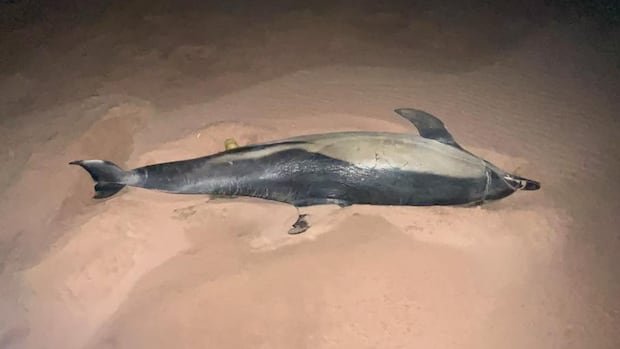

A dolphin found stranded on Blooming Point Beach last October underwent a necropsy revealing a severe infestation of parasites. Tonya Wimmer, the Marine Animal Response Society’s co-executive director, stated that the dolphin had severe pneumonia due to a heavy infestation of lungworms, affecting its ability to breathe.
The distress call regarding the stranded female common dolphin was received on the evening of October 10, 2025. Witnesses initially thought the animal was in good condition. Fisheries officials arrived at the scene approximately an hour later, finding the dolphin alive but struggling to breathe.
Due to late hour, windy conditions, and safety concerns, officials opted to leave the dolphin overnight and reassess the situation the following day. Unfortunately, by the next morning, the dolphin had passed away. The carcass was retrieved by provincial staff and taken to the Canadian Wildlife Health Cooperative for examination.
Veterinarians discovered that the dolphin had also been afflicted with flatworms, known as trematodes or flukes, in its ears, likely contributing to its disorientation and stranding. Wimmer highlighted the importance of responding to stranded wildlife promptly and appropriately, emphasizing the natural occurrence of such events.
Dolphins are typically social animals that travel in groups, making solitary discoveries like this concerning. Wimmer explained that the dolphin’s poor health, possibly caused by the parasite infestation, may have prevented it from staying with its pod. She encouraged people to remain vigilant and compassionate towards wildlife in distress, pointing out the community’s positive response to such incidents.