
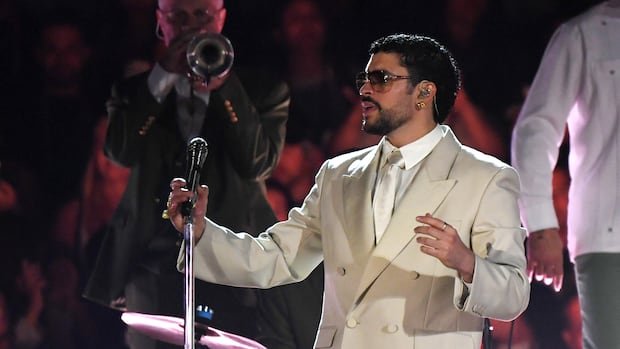

Puerto Rican Spanish, a rhythmic Caribbean dialect, has gained global recognition through the meteoric rise of Bad Bunny. While previously undervalued, experts suggest that the popularity of the Grammy Award-winning artist’s music is reshaping perceptions. In anticipation of his forthcoming Super Bowl halftime performance entirely in Spanish, numerous tutorials have emerged on social media and YouTube explaining Puerto Rican Spanish terms featured in Bad Bunny’s lyrics.
Notably, Bad Bunny’s album “DeBÍ TiRAR MáS FOToS” prominently showcases Puerto Rican Spanish elements, evident in phonetic spellings of song titles like “VeLDÁ,” which would conventionally be written as “verdad” in standard Spanish, meaning “true” or “truth” in English. According to Ramón Antonio Victoriano-Martinez, an assistant professor at the University of British Columbia, the album is distinctly Puerto Rican in its linguistic essence.
Victoriano-Martinez has observed a growing interest in learning Spanish among students over the past decade, largely influenced by reggaeton artists who perform in Puerto Rican Spanish. As someone from the Dominican Republic, he finds it uplifting to witness the widespread representation of Caribbean dialects.
Analyzing the dialect further, María Cristina Cuervo, an associate professor at the University of Toronto, highlights distinctive features such as the substitution of the “l” sound for “r” in certain words, a trait typical of Puerto Rican Spanish. Additionally, dropping the “s” sound at the end of specific words is another hallmark of the dialect, as seen in Bad Bunny’s songs.
Petra Rivera-Rideau, an associate professor at Wellesley College, notes the historical stigmatization of Puerto Rican Spanish in the Spanish-speaking world as unrefined or inauthentic. Rooted in Puerto Rico’s colonial history and the influence of English terminology, the dialect has often been marginalized. Rivera-Rideau emphasizes the significance of embracing linguistic diversity and reclaiming non-standard forms of Spanish.
Ana Celia Zentella, a professor emeritus at the University of California San Diego, expresses hope that Bad Bunny’s popularity will foster tolerance and pride among Spanish-speaking communities. In a time marked by immigration concerns, Zentella views Bad Bunny as an advocate for linguistic acceptance and justice, promoting respect for the rich linguistic tapestry that shapes American culture.