
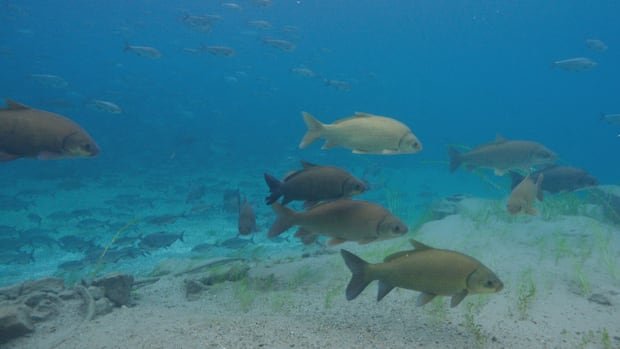

In Lake Huron, stunning underwater footage has revealed a location dubbed “fish city” by a documentary crew, showcasing an area near the Bruce Nuclear Generating Station where fish seem to thrive. However, the Saugeen Ojibway Nation (SON) disputes this characterization, labeling the site a “fish trap” instead. This disagreement stems from a significant fish die-off event, with up to five million gizzard shad perishing in 2025 due to clogging of the station’s cooling water intake systems. Additionally, several lake sturgeon, a culturally important and at-risk species in Anishnaabe teachings, became stranded at the plant.
The conflict over the “fish city” designation extends beyond mere imagery, raising concerns about how Bruce Power manages ecological risks. This issue is particularly pertinent as the company seeks regulatory approval to increase plant limits in order to enhance electricity production from its reactors.
SON contends that the warm-water outflow from the Bruce Nuclear Generating Station acts as a lure for fish, creating an attraction and entrapment scenario. Biologist Ryan Lauzon, who conducted a comprehensive study on the 2025 fish kill, emphasized that the thermal effluent serves as bait, drawing fish into the plant where they may become trapped.
Bruce Power, on the other hand, refutes claims that the plant was the direct cause of the 2025 fish die-off, attributing the incident to unusual environmental conditions. The company asserts that it has implemented various measures, such as nets and monitoring systems, to prevent a recurrence of such events.
In its bid to increase electricity output, Bruce Power has requested permission to raise its reactor capacity by about 11% by 2030. This proposal is under review, with a final hearing scheduled for July 2026. The company maintains that the planned power increase can be achieved safely within environmental limits.
Acknowledging the lack of clear benchmarks for assessing fish deaths related to plant operations, Bruce Power operates under stringent regulatory oversight. Despite efforts to mitigate risks, the absence of defined thresholds for acceptable fish losses poses a challenge in evaluating environmental impacts.
The controversy surrounding the fish deaths underscores not only ecological concerns but also cultural significance. The depletion of gizzard shad, considered an essential food source in the lake ecosystem, has implications for both the environment and Indigenous communities. The dispute highlights the need for a balanced approach to safeguarding wildlife and respecting cultural values.