
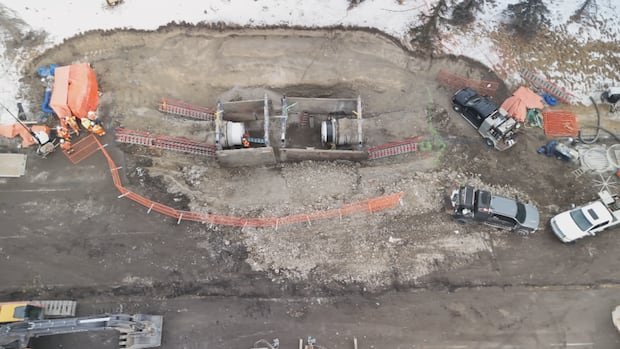

Calgary is facing several more days of work to fully restore its water system following the rupture of the Bearspaw feeder main. Officials provided details on Thursday about the ongoing repairs and testing that will extend into next week. The city mentioned that it is premature to determine when water restrictions will be lifted.
The replacement pipe has been successfully installed, and the crews are presently backfilling the excavation, according to Michael Thompson, the Infrastructure Services general manager. Subsequently, the crews will commence repaving the damaged section of 16th Ave. N.W. located above the feeder main.
In a statement released on Friday, the city indicated that road work is expected to commence over the weekend and may be open to traffic by midweek. Meanwhile, efforts are underway to gradually fill the pipe with water. Thompson emphasized on Thursday that there are three subsequent steps to restore the feeder main to service, each requiring careful attention due to potential risks and possible setbacks.
The city’s initial target was to complete repairs within two weeks from the pipe burst on December 30. However, uncertainties remain as to whether all the necessary work can be completed by the estimated deadline of January 13.
The process of refilling the replaced pipe with 22 million liters of water from the Bearspaw water treatment plant is anticipated to take approximately 48 hours. As the pressure increases during this phase, there is a heightened risk of another rupture, as mentioned by Thompson. Subsequent testing of the water quality is mandatory to ensure its cleanliness and safety, which involves a 24-hour monitoring period for any potential bacteria growth.
Following the testing phase, stabilization of the water system’s pressure will be required, a process that carries the highest level of risk and demands an additional 48 hours. Only after successfully completing all these steps can the water conservation measures be lifted gradually, with a specific timeline yet to be determined.
To mitigate the risk of further flooding in case of another water main break, the city is implementing certain measures. This includes the removal of sections of the Bow River flood barrier along Montgomery Blvd. N.W. opposite Bow View Manor, as highlighted by Sue Henry, chief of Calgary Emergency Management Agency. Additionally, actions such as clearing catch basins and modifying manhole covers are being taken to facilitate quicker drainage if necessary.
Mayor Jeromy Farkas emphasized that despite progress, the city is still facing challenges regarding water usage that may strain the system’s capacity, particularly during emergencies like firefighting. Recent statistics show that water consumption exceeded sustainable levels, prompting the urgent need for residents to reduce their daily water usage by 30 liters to ensure water supply adequacy.
In light of the current situation, residents are encouraged to adopt water conservation practices, such as shorter showers, reduced flushes, and optimizing dishwasher and washing machine usage. City officials have also advised against unnecessary activities like car washing to further alleviate strain on the water system.
The City of Calgary issued a water supply alert through the Alberta Emergency Alert on Wednesday, urging residents to conserve water intake. While not a critical alert requiring immediate action, officials are prepared to escalate alerts if necessary. The city aims to preserve critical alert notifications for situations that demand urgent citizen action.