
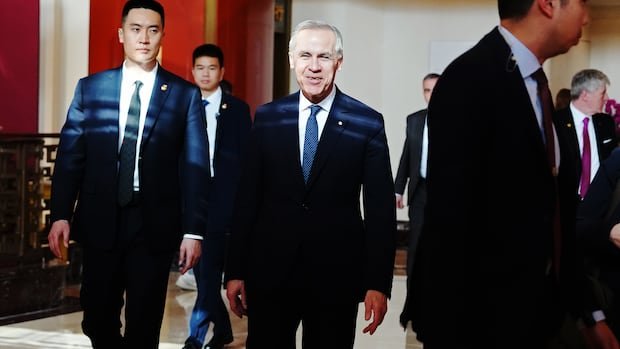

Prime Minister Mark Carney initiated discussions in Beijing, where the Canadian government and China agreed to enhance collaboration in clean and traditional energy sectors. Despite this positive step, the ongoing tariff dispute between the two nations remains unresolved.
The non-binding energy agreement signifies the commencement of high-level talks, a significant development that has not occurred for nearly a decade, according to a senior Canadian official. While Beijing did not commit to increasing purchases of Canadian petroleum and liquefied natural gas (LNG), Energy and Natural Resources Minister Tim Hodgson mentioned that China expressed interest in Canadian products.
The memorandum of understanding, an extension of a previous agreement, outlines discussions on oil and gas resource development, LNG, liquified petroleum gas, and emission reductions. Carney’s visit to China is aimed at improving relations and boosting non-U.S. exports over the next ten years, with upcoming meetings scheduled with China’s President Xi Jinping.
Despite the positive momentum, there is no indication of progress in resolving Beijing’s retaliatory tariffs on Canadian agricultural products, including canola. Canada and China signed an economic and trade co-operation roadmap to enhance trade, increase Canadian pet food exports to China, promote tourism, and reinforce existing agreements to combat crime.
Industry Minister Mélanie Joly described the current phase as a new partnership era with China. Carney highlighted the recent progress made in addressing longstanding issues between the two countries, setting the groundwork for a strategic partnership for the future.
Li, China’s Premier, expressed willingness to remove obstacles and enhance communication and trust, signaling a positive shift in relations. Negotiations are ongoing to persuade China to reduce tariffs on the agricultural sector, a key area of concern for Canadian officials.
Carney engaged in discussions with business leaders, including meetings with Contemporary Amperex Technology, a major Chinese company specializing in electric vehicle batteries. The possibility of welcoming more Chinese EV production in Ontario is under negotiation to lower tariffs, although specifics were not disclosed.
Meetings with Chinese officials, including Zhao Leji, chairman of the standing committee of the National People’s Congress, indicated China’s readiness to advance their strategic partnership. Carney expressed optimism about the progress in relations and the potential for Canada and China to become strategic partners in various areas, including energy and people-to-people connections.